
-
About Us
Why Choose Us?The company possesses advanced capabilities in mold design, injection molding, and automated assembly, supported by a professional quality inspection team to ensure product reliability. A dedicated design team continuously drives product innovation, providing customers with high-quality spray solutions.
 Coming From China, Marketing To The World.
 -
Products
-
News
 English
 Français
 русский
 Español
Precision Plastic Round Stick Containers for Deodorant, Sunscreen, and Balm Packaging
Content
- 1 Product Overview
- 2 Key Specifications and Application Summary
- 3 Why Round Stick Packaging Remains Popular
- 4 Capacity Strategy: 30g and 60g Options
- 5 Suitable Formulations and Product Categories
- 6 Advantages Over Competing Packaging Formats
- 7 Consumer Experience Benefits
- 8 Branding and Shelf Appeal
- 9 Material and Structural Considerations
- 10 Advanced Mold Design Capabilities
- 11 Injection Molding Strengths
- 12 Automated Assembly and Production Efficiency
- 13 Quality Inspection and Reliability
- 14 Large-Scale Manufacturing Capacity
- 15 Customization Possibilities
- 16 Supply Chain Advantages for Personal Care Brands
- 17 Sustainability and Practical Material Use
- 18 How This Container Supports Product Launch Success
- 19 Competitive Advantages in the Market
- 20 Practical Recommendations for Buyers
- 21 Q&A Section
- 21.1 Q1: What products can be packed in the 30g/60g plastic round stick container?
- 21.2 Q2: Why choose a round stick container instead of a jar?
- 21.3 Q3: What is the benefit of having both 30g and 60g sizes?
- 21.4 Q4: Can the container be customized?
- 21.5 Q5: What manufacturing processes support the quality of this container?
- 21.6 Q6: Is the container suitable for sunscreen sticks?
- 21.7 Q7: How does the container compare with roll-on packaging?
- 21.8 Q8: Why is quality inspection important for stick packaging?
- 22 Conclusion
- 23 References
- 24 Product: 30gram/60gram Plastic Round Stick Container
Modern personal care packaging must do more than hold a formula. It must protect the product, support smooth application, look clean on the shelf, feel comfortable in the hand, and perform reliably through production, transport, retail display, and daily consumer use. The 30gram/60gram plastic round stick container is designed for exactly this purpose. As a cylindrical stick package for deodorant, sunscreen, balm, and similar solid or semi-solid formulations, it combines practical capacity options with a familiar user experience and a manufacturing-friendly structure.
This container belongs to the deodorant stick bottle category, but its application range extends well beyond traditional underarm deodorant. The same format is suitable for sunscreen sticks, body balm, massage balm, anti-chafing sticks, fragrance balm, skin care sticks, and other personal care products requiring direct, controlled application. Its classic round profile makes it easy to grip, easy to rotate, and easy to apply across curved skin surfaces. For brands seeking a dependable stick container with flexible use, simple aesthetics, and efficient production compatibility, this packaging format offers a strong balance of usability and commercial practicality.
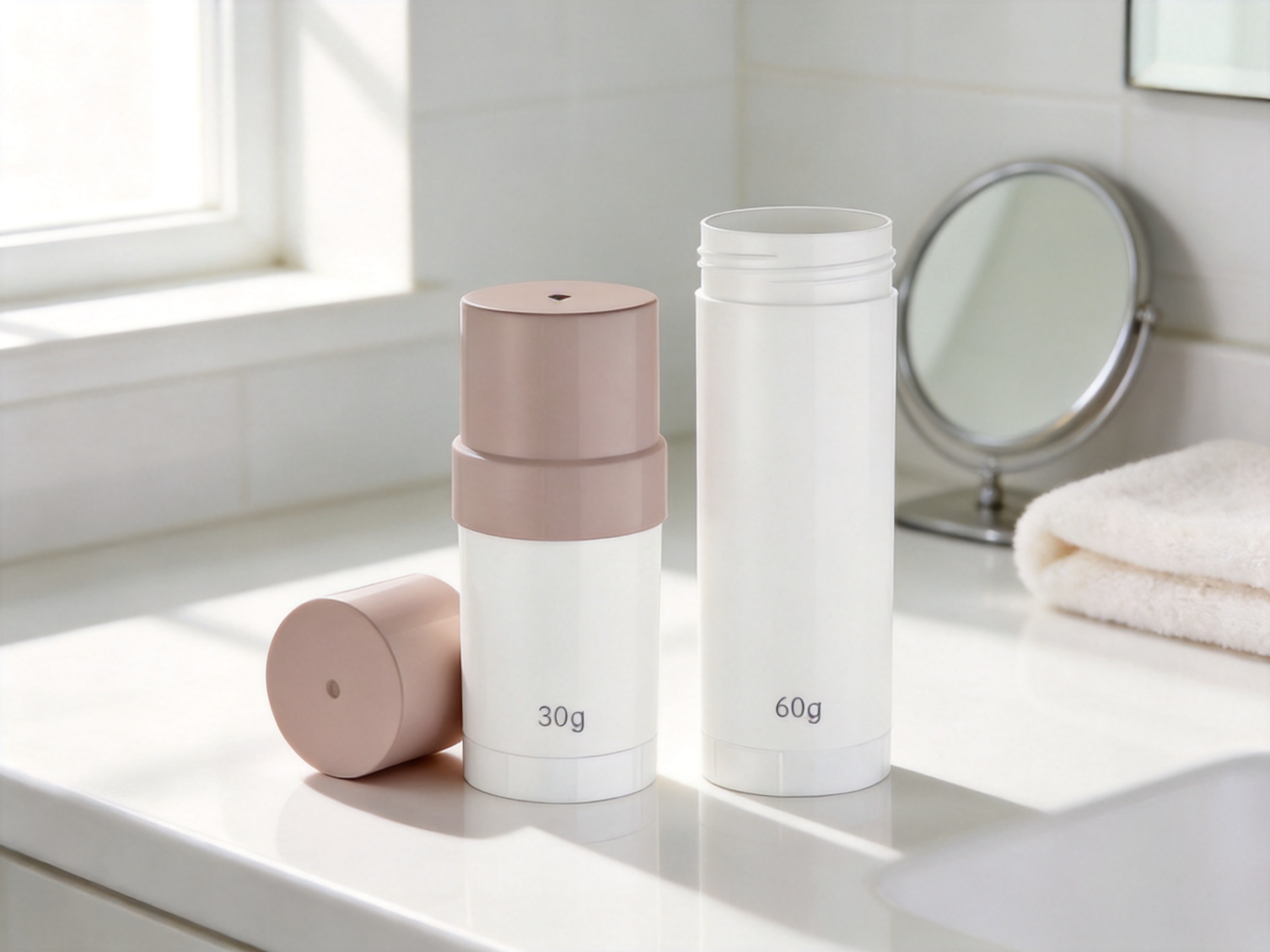
The product is available in convenient size options, including 30g and 60g capacities. The smaller 30g option is appropriate for travel, trial-size products, targeted skin care sticks, and premium compact items. The larger 60g option is suitable for standard retail deodorant, daily sunscreen sticks, family personal care products, and higher-volume balm formats. Together, these size choices allow personal care brands to build product lines with consistent design language while offering different retail positions.
The strength of this packaging is not only its shape or capacity. It is also supported by advanced manufacturing capabilities, including mold design, injection molding, automated assembly, quality inspection, and large-scale production management. With professional production experience in spray pumps, pump heads, caps, bottles, and personal care packaging components, the manufacturer can support customers from design communication to stable mass production. This makes the container especially valuable for brands that need both product reliability and supply chain confidence.
30gram/60gram Plastic Round Stick Container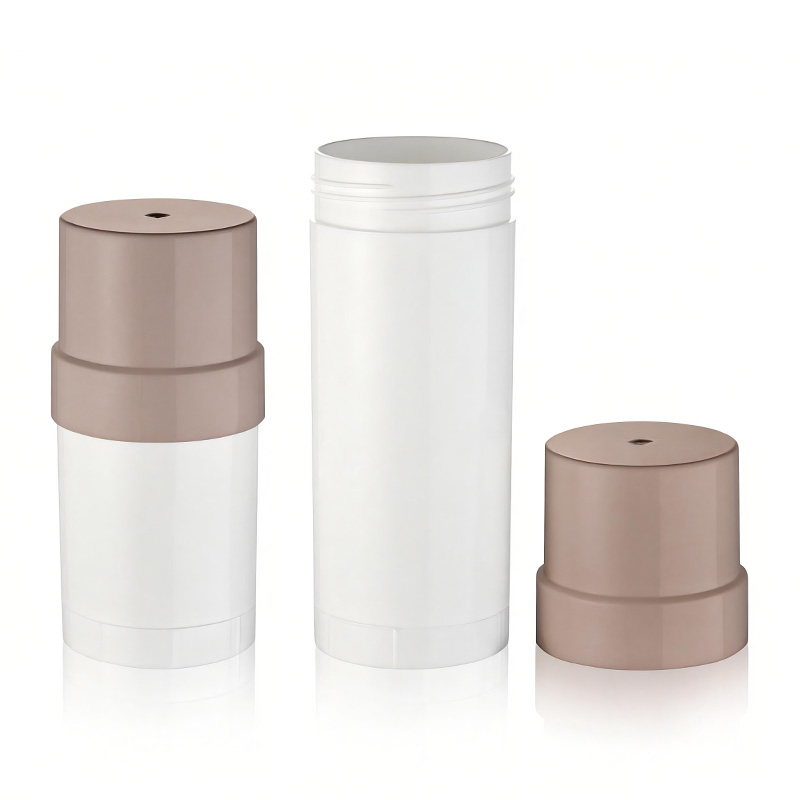
Product Overview
The 30gram/60gram plastic round stick container is a plastic packaging solution developed for stick-based personal care products. Its cylindrical body provides a classic, recognizable appearance that consumers already associate with deodorant and balm application. This familiarity can reduce user hesitation and support intuitive use, particularly in daily care categories where convenience and speed matter.
The container is intended for formulas that can be filled, cooled or set, and dispensed through a stick mechanism. Typical applications include deodorant, sunscreen, skin balm, body balm, and similar formulations. Depending on the formula system, the container may support wax-based, oil-based, or balm-like compositions that require controlled upward movement and direct contact application.
One of the key advantages of this round stick format is its balance between simplicity and versatility. Complex packaging can sometimes increase cost, increase assembly difficulty, and introduce more performance risks. By contrast, a classic cylindrical stick container provides a proven structural concept. It is easy to understand, easy to brand, and suitable for both mass-market and premium personal care positioning.
The container’s volume choices are also commercially useful. A 30g stick can support sample products, travel-friendly personal care, children’s products, premium concentrated formulas, and compact sunscreen sticks. A 60g stick can serve as a standard daily-use size for deodorant and sunscreen. This capacity range allows brands to launch coordinated product families without completely redesigning their packaging system for every size.
For manufacturers, the container is designed to be compatible with efficient production processes. Plastic components can be produced through injection molding with stable dimensions and repeatable quality. Automated or semi-automated assembly can help maintain output consistency. Quality inspection ensures that parts fit properly, rotate smoothly, and meet the functional requirements expected by brand owners and end consumers.
Key Specifications and Application Summary
Item |
Details |
Product Type |
Plastic round stick container |
Category |
Deodorant stick bottle |
Common Capacity Options |
30g and 60g |
Typical Uses |
Deodorant, sunscreen, balm, skin care stick, body care stick |
Shape |
Classic cylindrical round design |
Main Advantages |
Easy grip, controlled application, familiar consumer use, flexible branding, efficient production |
Manufacturing Support |
Mold design, injection molding, assembly, inspection, large-scale production capability |
Why Round Stick Packaging Remains Popular
Round stick packaging remains popular because it solves several problems at once. It gives the consumer a direct application method without needing fingers, brushes, pads, or additional tools. It protects the bulk of the product inside a closed plastic body. It is portable and can be carried in a bag, gym kit, travel pouch, or bathroom cabinet. It also offers a strong visual identity for personal care products that are designed for fast daily use.
The cylindrical design has ergonomic value. A round body naturally fits the hand and can be rotated during application. When a consumer applies deodorant or sunscreen, the package must move comfortably over the skin. Corners, sharp edges, or awkward profiles can reduce comfort. A smooth round shape gives a pleasant handling experience and supports even product movement.
The round stick format also helps brands communicate practicality. A consumer looking at a cylindrical deodorant or sunscreen stick immediately understands how it is used. This instant recognition can improve retail conversion. In crowded personal care categories, packaging that requires no explanation has a real advantage. A clean round stick container can be decorated, labeled, colored, or finished to match different brand identities while preserving easy usability.
Compared with jars, round stick containers reduce the need for direct hand contact with the formula. This can improve perceived hygiene, especially for products used outside the home. Compared with tubes, stick containers can offer more controlled solid application and may reduce mess. Compared with bottles or pumps, stick packaging is more suitable for waterless or low-water balm systems and can support compact, travel-friendly formats.
The design is also production-friendly. Cylindrical plastic parts are suitable for mold development and efficient injection molding. The shape can be produced consistently at scale, and the assembly structure can be standardized. For brands that need reliable supply and repeatable quality, this matters as much as external appearance.
Capacity Strategy: 30g and 60g Options
Choosing the right capacity is one of the most important packaging decisions for a personal care product. A package that is too small may not deliver enough perceived value. A package that is too large may feel bulky, increase material cost, or exceed the needs of the intended product. The availability of 30g and 60g options gives brands practical flexibility.
The 30g size is ideal for compact personal care products. It can be used for travel deodorant, targeted sunscreen application, premium balm, facial stick, hand balm, or promotional product launches. This size is especially useful when the formula is high-value or when the product is designed for specific application zones rather than full-body use. For example, a sunscreen stick for the face, nose, ears, or hands may not require a large container. A 30g package can feel convenient and refined.
The 60g size is more suitable for daily-use products with regular consumption. Standard deodorant products often benefit from a larger size because consumers expect extended use. Sunscreen sticks for outdoor activities, family use, sports, and travel may also require more volume. A 60g stick can communicate better value while maintaining a hand-friendly profile.
Using both capacities in a product family can create a clear brand architecture. A company may launch a 30g travel version and a 60g full-size version with similar colors, labels, and cap design. This helps consumers recognize the same product line across different sizes. Retailers also benefit from a coherent shelf appearance.
From a manufacturing perspective, offering multiple sizes can be supported through related mold systems and consistent production management. If the container family shares design principles, brands can reduce development complexity while still giving consumers meaningful choices. This is one reason why the 30g/60g round stick container is commercially attractive.
Suitable Formulations and Product Categories
The container is compatible with a wide range of balm and stick formulations. Deodorant is the most obvious application. Stick deodorants require packaging that can hold a solid or semi-solid mass, allow upward movement, and support direct skin contact. The container’s round structure helps create a smooth application experience for underarm use.
Sunscreen is another strong application. Sunscreen sticks are increasingly popular because they are portable, less messy than liquid sunscreen, and convenient for reapplication. They are especially useful for face, neck, ears, shoulders, and children’s use. A plastic round stick container can protect the sunscreen formula while allowing clean and controlled application during outdoor activities.
Balm products are also well suited to this format. Body balm, moisturizing balm, anti-chafing balm, after-sun balm, and massage balm can all be packaged in stick form. The consumer can apply the product directly without scooping from a jar. This improves convenience and can create a more premium user experience.
Skin care sticks are becoming more common in beauty and personal care markets. Products such as facial moisturizing sticks, solid serum sticks, cooling sticks, and barrier repair sticks need packaging that looks clean and feels easy to use. The round stick container provides a simple base for these categories and can be customized through color, labeling, and surface finish.
The packaging may also support niche applications such as insect-repellent sticks, sports balm, foot care sticks, fragrance balm, and men’s grooming sticks. This broad compatibility gives brands more freedom to use one container platform across multiple product concepts.
Advantages Over Competing Packaging Formats
In personal care packaging, every format has strengths and limitations. The round plastic stick container offers several advantages when compared with jars, tubes, roll-ons, bottles, and rectangular stick packages.
Compared with Jars
Jars are common for creams and balms, but they usually require the consumer to touch the formula with fingers or use a spatula. This can be inconvenient during travel, sports, or outdoor use. A stick container allows direct application, reducing mess and improving speed. For deodorant and sunscreen especially, consumers often prefer a no-finger application method.
Jars can also expose more product surface area to air each time they are opened. A stick container keeps most of the formula protected inside the body and exposes only the application surface. This can help preserve product cleanliness and improve user confidence.
Compared with Tubes
Tubes work well for creams and gels, but they can be less suitable for solid balm formulas. A tube requires squeezing, which can lead to over-dispensing or uneven control. Stick packaging delivers the formula in a more structured way. The product rises as needed and is applied directly to the skin. For waxy or solid formulas, this is often more appropriate.
Tubes may also become messy around the opening, especially with oily or thick products. A stick container is designed to keep the application surface organized and contained. The cap helps cover the exposed product between uses.
Compared with Roll-On Bottles
Roll-on packaging is useful for liquid deodorants and some skin care products, but it is not designed for solid sticks. Roll-ons depend on a rolling ball system and low-viscosity formulas. A plastic stick container is better for balm, wax, and solid deodorant systems. It gives formulators more freedom to create waterless or concentrated products.
Roll-ons may also feel wet during application, while stick products can feel dry, smooth, or balm-like depending on the formula. Many consumers prefer stick deodorants because they are quick, familiar, and easy to control.
Compared with Rectangular Stick Containers
Rectangular or oval stick containers can offer a wide application surface, but round containers provide a classic look and comfortable grip. The cylindrical shape is easy to rotate and may feel more balanced in the hand. It also offers a clean visual style suitable for minimalist, natural, clinical, or premium branding.
Round containers can be easier to integrate into product families where other bottles, caps, or cosmetic components already use cylindrical forms. This visual consistency can improve brand recognition across shelves and online product images.
Compared with Complex Custom Packaging
Highly customized packaging can be attractive, but it often requires higher tooling investment, longer development time, more complicated quality control, and greater risk of production delay. A proven round stick container provides a dependable structure that can still be customized in appearance. This balance helps brands shorten launch timelines while maintaining professional presentation.
Consumer Experience Benefits
Consumers judge packaging every time they use a product. A package may look attractive on the shelf, but if it is difficult to open, awkward to hold, or messy to apply, it can damage the overall product impression. The round stick container supports a positive experience through simplicity and familiarity.
The cylindrical body can be held naturally in one hand. The user can remove the cap, twist or push the mechanism according to the design, and apply the product directly. The package does not require complicated instructions. This is especially important for products used daily, such as deodorant, where consumers expect speed and consistency.
For sunscreen, the stick format can encourage reapplication. Many consumers avoid reapplying sunscreen because creams can feel messy or inconvenient. A portable stick makes reapplication easier during outdoor activities, commuting, hiking, swimming, or sports. The package can be carried in a bag and used without washing hands immediately afterward.
For balm products, direct application improves convenience. Anti-chafing balm, body balm, and moisturizing balm are often used on specific areas. A round stick container allows targeted application and helps avoid waste. The user can apply only where needed.
The cap also plays an important role. A secure cap helps protect the product surface from dust and accidental contact. A well-fitted cap gives the consumer confidence that the product can be carried safely. In personal care categories, small functional details like cap fit can strongly affect perceived quality.
Branding and Shelf Appeal
The round stick container provides a versatile foundation for brand presentation. Its smooth cylindrical body can support labels, printing, color matching, and customized surface finishes. A brand can create a clean clinical appearance, a colorful youth-focused design, a natural personal care look, or a premium minimalist style using the same basic structure.
The round shape works well for wraparound labels, allowing brands to display product name, function, ingredients, usage instructions, and regulatory information. For e-commerce, the clean vertical profile photographs well and can be shown clearly in product listings. For retail, the recognizable stick format helps shoppers immediately understand the product’s function.
Color customization can be used to distinguish formulas. For example, a deodorant line might use different cap colors for fresh, floral, unscented, and sport versions. A sunscreen line might use bright outdoor colors for children’s products and clean white or pastel tones for facial sunscreen. A balm line might use neutral or botanical colors to suggest skin care benefits.
The container can also support private label and custom projects. Personal care brands, contract fillers, and distributors often need packaging that can be adapted to different market needs without requiring a completely new structural design. A dependable round stick container gives them that flexibility.
Material and Structural Considerations
Plastic is widely used in personal care packaging because it is lightweight, moldable, durable, and suitable for mass production. For stick containers, plastic components must be designed to maintain dimensional stability and functional fit. The body, cap, base, and internal mechanism must work together smoothly.
A good stick container requires careful wall thickness control. If the walls are too thin, the package may feel weak or deform during transport. If they are too thick, material cost increases and cooling time during molding may be longer. Balanced design helps achieve strength, appearance, and production efficiency.
The internal mechanism is also important. Stick packaging must support controlled product movement. Consumers expect the product to rise smoothly and remain stable during use. Loose parts, uneven movement, or poor fit can create dissatisfaction. Precision mold design and consistent molding conditions help reduce these risks.
The cap must fit securely but remain easy to remove. If the cap is too loose, it may detach in a bag or during shipment. If it is too tight, consumers may struggle to open the package. Achieving the right fit depends on accurate dimensions, material selection, and quality inspection.
The container surface should also support decoration. Labels need a smooth and consistent area for adhesion. Printed or colored parts need stable surface quality. A clean molded finish improves both appearance and manufacturing efficiency.
Advanced Mold Design Capabilities
Strong packaging begins with strong mold design. For a plastic round stick container, the mold determines the accuracy, repeatability, and appearance of the final product. Advanced mold design allows the manufacturer to control dimensions, parting lines, surface finish, wall thickness, and assembly compatibility.
A professional mold design process begins with understanding the intended product use. The packaging must be suitable for deodorant, sunscreen, or balm formulas. The design team considers filling requirements, assembly process, cap fit, labeling area, and consumer handling. This practical approach helps prevent problems before mass production begins.
Computer-aided design tools can be used to refine part geometry. Engineers can evaluate whether the component can be molded efficiently, whether the structure is strong enough, and whether the assembly will function as expected. Mold flow considerations are also important because plastic must fill the cavity evenly. Poor flow can cause defects such as short shots, sink marks, warpage, or visible surface flaws.
Tooling precision is especially important for components that must fit together. A small dimensional error can affect cap retention, twist movement, or assembly alignment. Experienced mold development helps maintain stable tolerances and reduce the need for repeated corrections.
For customers, advanced mold design means more reliable project development. It supports faster sampling, better product consistency, and fewer production disruptions. It also allows more customization options, such as adjusted capacities, cap styles, surface textures, and color designs, depending on project requirements.

Injection Molding Strengths
Injection molding is one of the core processes used to manufacture plastic packaging components. In this process, plastic material is heated, injected into a mold cavity, cooled, and ejected as a formed part. For stick containers, injection molding can produce bodies, caps, bases, and internal components with high repeatability.
High-quality injection molding depends on several factors: stable machines, well-designed molds, appropriate materials, controlled temperature, proper injection pressure, cooling balance, and trained operators. When these elements are managed correctly, the result is consistent part quality across large production runs.
For the round stick container, dimensional consistency is essential. The cap must fit the body. The base must connect correctly. The internal mechanism must move smoothly. Injection molding provides the precision needed to maintain these relationships. A manufacturer with advanced injection molding capability can produce high volumes while keeping quality stable.
Surface appearance is another key factor. Personal care packaging must look clean and professional. Defects such as flash, scratches, sink marks, color unevenness, or deformation can reduce consumer confidence. Controlled molding processes help minimize these issues.
Production efficiency also matters. Personal care brands often need reliable delivery schedules, especially for seasonal sunscreen, promotional deodorant launches, or large retail programs. Efficient injection molding capacity supports timely supply and helps brands avoid stock shortages.
Automated Assembly and Production Efficiency
After molding, stick container components must be assembled accurately. Assembly may include joining the body, base, internal elevator or platform, screw mechanism, and cap. The exact structure depends on the specific design, but the principle is the same: each component must fit correctly and function smoothly.
Automated assembly improves consistency. Manual assembly can be suitable for small batches or special projects, but high-volume packaging requires stable and repeatable assembly methods. Automation can reduce human error, improve output speed, and support more consistent product performance.
For a manufacturer with strong automated assembly capability, large orders can be managed more efficiently. This is particularly important when serving global personal care customers who require dependable lead times and consistent specifications. Automated assembly also supports cleaner production flow because components can move through organized stations with controlled handling.
Production efficiency is not only about speed. It is also about reducing waste, improving yield, and ensuring that finished components meet customer expectations. A well-managed production line can detect problems early and prevent defective parts from moving forward. This protects both the manufacturer and the customer.
For brands, efficient assembly can translate into better cost control and more reliable supply. In competitive personal care markets, packaging delays can affect product launches and sales campaigns. A manufacturer with strong production organization helps reduce this risk.
Quality Inspection and Reliability
Quality inspection is essential for packaging that will be used daily by consumers. A stick container must not only look correct; it must perform correctly. Inspection can include appearance checks, dimensional measurement, cap fit testing, assembly function testing, rotation or movement testing, and packaging protection checks.
Appearance inspection ensures that the product has a clean surface, consistent color, and acceptable finish. Since personal care packaging is closely connected to brand image, visible defects can be unacceptable. Consumers often judge product quality before opening the package, so appearance matters.
Dimensional inspection confirms that molded parts meet specification. Even small deviations can affect assembly and function. For example, a cap that is slightly oversized may not hold securely, while one that is undersized may be too difficult to remove. The internal mechanism also requires dimensional accuracy for smooth movement.
Functional inspection checks whether the container works as intended. The base should operate properly, the product platform should move smoothly, and the assembled container should feel stable. A stick container that fails during consumer use can lead to complaints and damage brand trust.
Packaging and transport inspection may also be important. Finished components must be packed to prevent scratches, deformation, or contamination during shipment. Reliable export packaging helps ensure that customers receive usable products after long-distance transport.
Large-Scale Manufacturing Capacity
Personal care packaging customers often need suppliers that can handle both development and volume production. A manufacturer with daily output capacity reaching large quantities can support growing brands, contract manufacturers, and established companies with demanding supply requirements.
Large-scale capacity is valuable because personal care product demand can fluctuate. Deodorant may have steady year-round demand, while sunscreen often experiences seasonal peaks. A supplier with strong production capacity can better support these changes and help customers plan inventory.
Scale also supports cost efficiency. When production is organized for high output, material purchasing, machine utilization, assembly planning, and labor management can be optimized. This may help provide competitive pricing while maintaining quality standards.
However, capacity alone is not enough. It must be combined with engineering knowledge, quality control, and customer service. The best packaging partner is not simply the one that produces the most units, but the one that can produce reliable units repeatedly and respond to project needs professionally.
In this respect, the manufacturing background behind the 30g/60g round stick container is significant. Experience in pump heads, caps, bottles, sprayers, and daily chemical packaging gives the manufacturer a broad understanding of plastic packaging systems. This experience supports better problem-solving and more dependable product development.
Customization Possibilities
Many personal care brands require packaging that reflects their identity. The round stick container can support multiple customization directions depending on project volume, technical feasibility, and customer requirements.
Color customization is one of the most common options. The body, cap, and base can be produced in different colors to match brand guidelines or product variants. A natural deodorant brand may choose soft earth tones, while a sports sunscreen brand may select bright, energetic colors.
Surface finish can also influence the final appearance. Glossy finishes can communicate cleanliness and brightness. Matte finishes can feel modern, premium, or natural. Textured elements may improve grip or create a distinctive tactile experience.
Labeling is another flexible decoration method. A cylindrical body is suitable for wraparound labels that provide strong graphic coverage. Labels can be changed for different markets, languages, scents, or product claims without changing the molded package itself.
For larger projects, structural customization may be possible. Brands may request adjustments to cap shape, base design, capacity, or functional details. Such projects require careful engineering review to ensure that the customized package remains manufacturable and reliable.
Customization should always balance creativity with performance. A beautiful package that does not assemble well or fails during use is not successful. The advantage of working with an experienced manufacturer is that design ideas can be evaluated from both branding and production perspectives.
Supply Chain Advantages for Personal Care Brands
Packaging is a critical part of the personal care supply chain. Even when a formula is ready, a product cannot launch without packaging. Delays, inconsistent quality, or poor communication can create serious business problems. Choosing a capable packaging manufacturer helps reduce these risks.
The round stick container benefits from being part of a broader personal care packaging production system. The manufacturer’s experience with perfume sprayers, pump heads, lotion pumps, caps, bottles, trigger sprayers, droppers, airless bottles, cream jars, roll-on bottles, and other packaging categories demonstrates a wide technical foundation. This matters because customers often need multiple packaging components for a full product line.
A brand may purchase deodorant stick containers, lotion pumps, mist sprayers, and bottles from related supply channels. Working with a manufacturer that understands various packaging types can simplify communication and improve consistency. It can also support future product expansion.
Strong supply chain support includes sample development, specification confirmation, production scheduling, quality control, packing, and shipment coordination. Each step must be managed carefully. For export customers, communication and documentation are especially important because packaging must arrive on time and meet agreed standards.
By combining manufacturing capacity with packaging experience, the supplier can support both emerging brands and established companies seeking dependable personal care packaging solutions.
Sustainability and Practical Material Use
Sustainability is an increasingly important topic in personal care packaging. While plastic remains widely used because of its performance and production efficiency, brands and manufacturers are paying more attention to material reduction, durability, recyclability considerations, and responsible production.
A well-designed stick container can contribute to practical sustainability by using material efficiently. Proper wall thickness avoids unnecessary plastic use while maintaining strength. Durable construction helps reduce damage and waste during transport. Reliable performance reduces the risk of rejected or returned products.
Stick formats can also support concentrated or waterless formulations. Deodorant sticks, sunscreen sticks, and balms often contain less water than lotions or creams. Concentrated products may require less packaging volume for the same number of uses, depending on the formula. This can be attractive for brands seeking compact and efficient personal care formats.
Manufacturing efficiency also matters. Stable injection molding, good yield rates, and controlled assembly help reduce production waste. Quality inspection prevents defective products from reaching customers, but the best approach is to design and produce correctly from the beginning.
Brands interested in sustainability should discuss material options, decoration methods, and recycling considerations during project development. A practical packaging solution should balance environmental goals with safety, compatibility, cost, and consumer usability.

How This Container Supports Product Launch Success
A successful product launch requires alignment between formula, packaging, manufacturing schedule, brand design, and market expectations. The 30g/60g round stick container supports this process by providing a dependable packaging base for multiple personal care categories.
For a deodorant launch, the container offers a familiar format that consumers understand immediately. The brand can focus on formula benefits, scent, natural ingredients, long-lasting protection, or skin-friendly claims while relying on a proven package structure.
For a sunscreen launch, the stick format can emphasize convenience, portability, clean application, and targeted protection. The 30g size may suit facial sunscreen or travel products, while the 60g size can support broader daily use.
For a balm launch, the container can communicate practicality and hygiene. Consumers can apply the balm directly to skin without touching the formula. This is useful for body care, sports care, after-sun care, and therapeutic-style personal care products.
From a project management perspective, selecting an existing round stick container can reduce development risk compared with creating a fully custom package from zero. Brands can still customize color and decoration, but they benefit from an established structural concept and manufacturing experience.
Competitive Advantages in the Market
The personal care packaging market is competitive, with many suppliers offering basic stick containers. The advantage of this product lies in the combination of classic design, flexible capacity, application versatility, and manufacturing support.
First, the round cylindrical design is proven and user-friendly. It avoids unnecessary complexity and focuses on daily usability. Consumers can grip, open, and apply the product easily. This gives it an advantage over packages that look unusual but feel less practical.
Second, the 30g and 60g capacity options allow brands to serve different retail needs. Many competitors may offer only one standard size or require separate sourcing for travel and full-size products. A coordinated capacity range supports better product planning.
Third, the container is suitable for several formula categories. Its use is not limited to deodorant. Sunscreen, balm, skin care stick, and other personal care products can all use the format. This versatility makes it valuable for brands with multiple product concepts.
Fourth, manufacturing capability strengthens the product offer. Advanced mold design, injection molding, automated assembly, and quality inspection help ensure that the container is not merely attractive but reliable at scale. Competitors with weaker process control may struggle with inconsistent cap fit, poor surface finish, or unstable assembly.
Fifth, the supplier’s broader packaging experience supports better customer service. Knowledge of caps, bottles, pumps, sprayers, droppers, and jars allows more complete packaging consultation. This can be especially useful for brands developing full personal care collections.
Practical Recommendations for Buyers
Before selecting a stick container, buyers should confirm several details. The first is formula compatibility. The packaging should be tested with the actual deodorant, sunscreen, or balm formula under expected filling, cooling, storage, and use conditions. Compatibility testing helps identify issues such as leakage, deformation, staining, odor interaction, or poor movement.
The second detail is filling process compatibility. Some formulas are hot-filled, while others may be filled under specific temperature conditions. Buyers should confirm whether the container can support their filling method and whether any special handling is required.
The third detail is decoration method. If a brand plans to use labels, printing, or color matching, these specifications should be confirmed early. Label dimensions, surface finish, and color tolerance should be discussed before mass production.
The fourth detail is packaging and logistics. Buyers should understand how the containers will be packed, how many units fit per carton, and how they will be protected during shipment. Export orders require careful packing to avoid scratches and deformation.
The fifth detail is order planning. Personal care launches often involve deadlines. Buyers should discuss sampling time, mold availability, production lead time, inspection requirements, and shipment schedules. Clear communication helps avoid delays.
Q&A Section
Q1: What products can be packed in the 30g/60g plastic round stick container?
A1: The container is suitable for deodorant, sunscreen, body balm, skin care stick, anti-chafing balm, fragrance balm, and similar solid or semi-solid personal care formulations. It is especially useful when direct, controlled application is required.
Q2: Why choose a round stick container instead of a jar?
A2: A round stick container allows direct application without requiring fingers to touch the formula. It is cleaner, faster, and more portable than many jar formats, making it ideal for daily-use products such as deodorant and sunscreen.
Q3: What is the benefit of having both 30g and 60g sizes?
A3: The 30g size is suitable for compact, travel, trial, or targeted-use products, while the 60g size works well for standard daily-use items. Together, they allow brands to build a coordinated product line with different retail options.
Q4: Can the container be customized?
A4: Customization may include color, label design, surface finish, and project-specific adjustments depending on order quantity and technical feasibility. Buyers should discuss branding and structural requirements during the early development stage.
Q5: What manufacturing processes support the quality of this container?
A5: The container is supported by mold design, injection molding, automated assembly, and quality inspection. These processes help ensure accurate dimensions, reliable cap fit, smooth operation, and consistent appearance.
Q6: Is the container suitable for sunscreen sticks?
A6: Yes. The round stick format is well suited to sunscreen sticks because it is portable, easy to apply, and convenient for reapplication. Formula compatibility and filling conditions should be tested before mass production.
Q7: How does the container compare with roll-on packaging?
A7: Roll-on packaging is designed mainly for liquid formulas, while stick containers are better for solid, wax-based, or balm-like formulas. A stick container provides a drier and more controlled application experience.
Q8: Why is quality inspection important for stick packaging?
A8: Quality inspection ensures that the cap fits properly, the mechanism functions smoothly, the dimensions are accurate, and the appearance meets brand standards. This helps prevent consumer complaints and protects brand reputation.
Conclusion
The 30gram/60gram plastic round stick container is a practical and competitive packaging solution for deodorant, sunscreen, balm, and related personal care products. Its classic cylindrical design provides comfortable handling, direct application, strong portability, and familiar consumer use. The 30g and 60g capacity options give brands flexibility for travel-size, compact, standard, and daily-use product lines.
Compared with jars, tubes, roll-ons, and overly complex custom packages, this round stick container offers a balanced combination of cleanliness, convenience, manufacturability, and branding flexibility. It helps consumers apply products easily while helping brands create organized and attractive retail presentations.
The product’s value is strengthened by advanced manufacturing capabilities. Professional mold design, stable injection molding, automated assembly, and systematic quality inspection support reliable performance at scale. Experience across personal care packaging categories further enhances the ability to serve global customers with practical, high-quality solutions.
For brands developing deodorant sticks, sunscreen sticks, skin care sticks, or balm-based products, this container provides a dependable foundation. It is simple enough for efficient production, versatile enough for multiple applications, and refined enough to support modern personal care branding.
References
1. Soroka, W. Fundamentals of Packaging Technology. Institute of Packaging Professionals.
2. Yam, K. L. The Wiley Encyclopedia of Packaging Technology. Wiley.
3. Robertson, G. L. Food Packaging: Principles and Practice. CRC Press.
4. Selke, S. E. M., Culter, J. D., and Hernandez, R. J. Plastics Packaging: Properties, Processing, Applications, and Regulations. Hanser Publications.
5. The Cosmetic, Toiletry and Fragrance Association. Cosmetic Packaging and Labeling Guidance.
6. Ashby, M. F. Materials and the Environment: Eco-Informed Material Choice. Butterworth-Heinemann.
Product: 30gram/60gram Plastic Round Stick Container

-
What Makes a Good Deodorant Stick Bottle for Brands?
A deodorant stick bottle is a twist-up or push-up dispensing container designed to hold and advance...
-
Deodorant Containers Eco Friendly: Sustainable Bottle Guide
Deodorant Containers Eco Friendly: The Direct Answer The most eco-friendly deodorant containers are...
-
Amber Plastic Bottles: Lightweight, Protective, Customizable Packaging for Cosmetics
You have spent months stabilizing a vitamin C serum, only to watch a pallet of amber glass bottles ...
-
Crimp Pumps Demystified: Choosing the Right Type and Material for Every Cosmetic Formula
Walk into any cosmetic filling facility and you will find crimp pumps on everything from a delicate ...
Copyright © GreenYard Tools Co.,ltd. All Rights Reserved.
Personal Care Packaging Manufacturer Custom Perfume Sprayers Factory