
-
About Us
Why Choose Us?The company possesses advanced capabilities in mold design, injection molding, and automated assembly, supported by a professional quality inspection team to ensure product reliability. A dedicated design team continuously drives product innovation, providing customers with high-quality spray solutions.
 Coming From China, Marketing To The World.
-
Products
-
News

 English
 Français
 русский
 Español
Versatile Ribbed Twist Caps for Personal Care, Household, and Food Packaging
Content
- 1 1. Product Overview
- 2 2. Main Specifications
- 3 3. Why the Ribbed Design Matters
- 4 4. Size Compatibility and Neck-Finish Selection
- 5 5. Applications in Personal Care Packaging
- 6 6. Applications in Household Products
- 7 7. Potential Use in Food Packaging
- 8 8. Advantages Compared with Less Specialized Closures
- 9 9. Manufacturing Capabilities
- 10 10. Process Strengths That Support Customer Value
- 11 11. Material, Color, and Customization Considerations
- 12 12. Quality Testing Recommendations
- 13 13. Integration with Different Bottle Types
- 14 14. Sustainability and Resource Efficiency
- 15 15. Supply and Production Advantages
- 16 16. Comparison with Alternative Closure Types
- 17 17. Design and Branding Opportunities
- 18 18. Purchasing Checklist
- 19 19. Why Work with an Experienced Packaging Manufacturer?
- 20 20. Frequently Asked Questions
- 20.1 Q1: What is the GY-209A Plastic Twist Cap used for?
- 20.2 Q2: Which sizes are available?
- 20.3 Q3: What does the ribbed design do?
- 20.4 Q4: Can this cap be used with any bottle?
- 20.5 Q5: Is the cap suitable for food packaging?
- 20.6 Q6: Is this cap suitable for thick lotion?
- 20.7 Q7: How does it compare with a lotion pump?
- 20.8 Q8: Can the cap be used with PE and PET bottles?
- 20.9 Q9: Can the cap color be customized?
- 20.10 Q10: What manufacturing capabilities does GreenYard provide?
- 20.11 Q11: What is the stated production capacity?
- 20.12 Q12: What testing should be completed before approval?
- 20.13 Q13: Is the cap recyclable?
- 20.14 Q14: Can the cap be used for products other than those listed?
- 20.15 Q15: How can buyers request more information?
- 21 21. Conclusion
- 22 References
- 23 Product: Plastic Twist Cap
Packaging closures play a decisive role in product protection, dispensing performance, shelf presentation, and consumer convenience. Although a cap may appear to be a simple component, its thread compatibility, sealing performance, grip, opening mechanism, material quality, and production consistency all influence the overall value of a packaged product. The GY-209A Plastic Twist Cap is designed as a practical closure solution for personal care, household, and selected food packaging applications. With multiple neck-finish options, a ribbed exterior, and a straightforward twist-opening structure, it offers a balance of versatility, usability, and dependable closure performance.
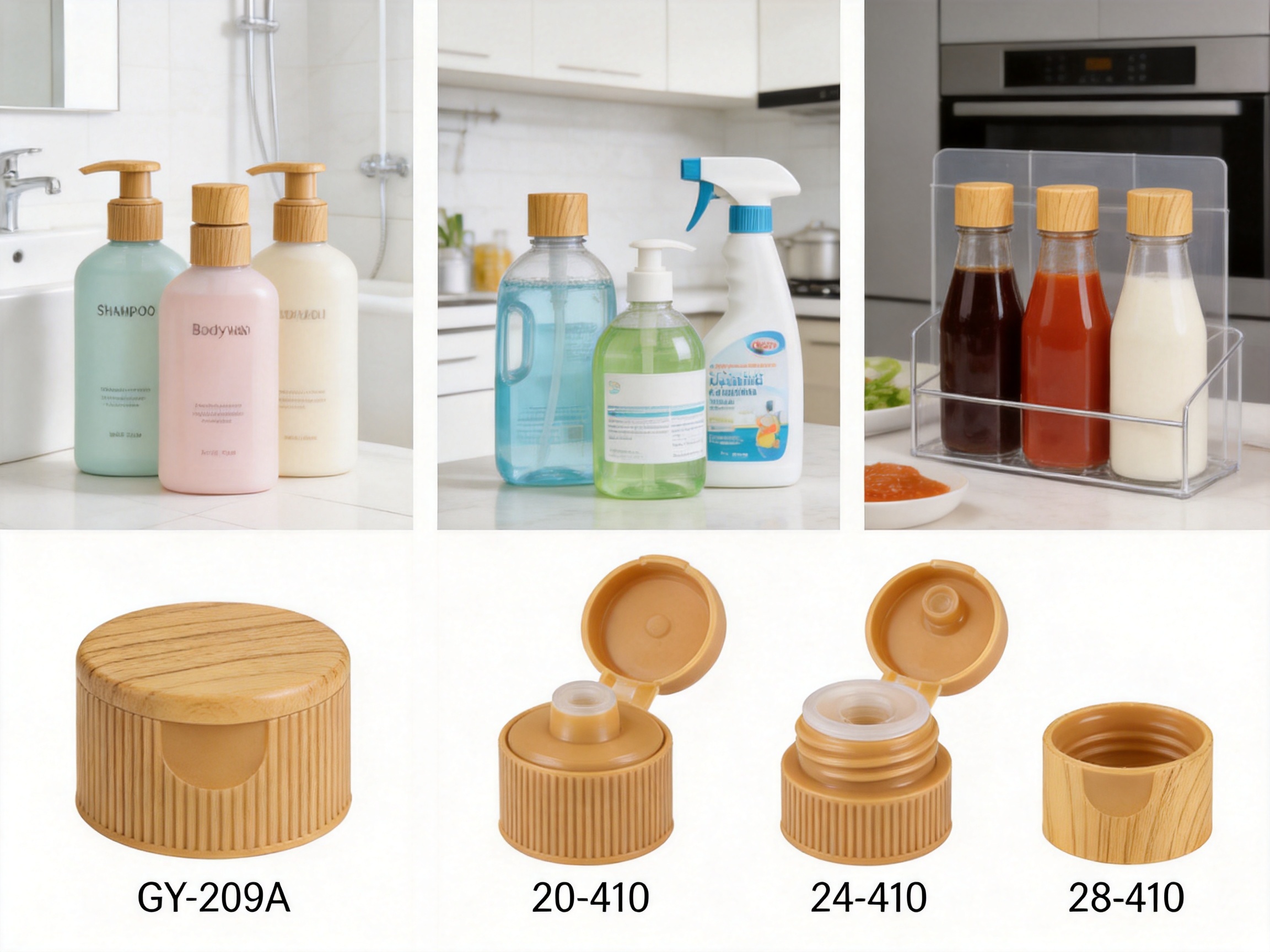
The cap belongs to the cosmetic plastic packaging bottle cap category and is suitable for bottles containing shampoo, lotion, body wash, dishwashing liquid, sauces, and similar liquid or semi-liquid products. Its design supports everyday use while allowing manufacturers to standardize closure selection across different product lines. The available options include 18-410, 20-410, 24-410, and 28-410 according to the product listing, while the detailed specification identifies 20-410, 24-410, and 28-410 as the principal size options. Buyers should confirm the required neck finish and final production specification before placing an order.
Manufactured by GreenYard Tools Co., Ltd., the cap reflects the company’s wider experience in packaging components, including perfume sprayers, pump heads, caps, bottles, and daily chemical packaging solutions. The manufacturer combines mold design, injection molding, automated assembly, and quality inspection to support reliable, high-volume production. Its stated daily production capacity of one million units enables it to serve customers requiring repeatable packaging components for domestic and international markets.
This article examines the cap’s structure, applications, benefits, manufacturing strengths, compatibility considerations, quality factors, and purchasing value. It also explains why a well-designed twist cap can provide a competitive advantage over less ergonomic or less standardized closure alternatives.

Plastic Twist Cap
1. Product Overview
The GY-209A is a plastic twist cap designed for use with compatible threaded bottles. Its core function is to close the container securely while providing the user with a convenient way to open and reseal the package. The cap uses a ribbed exterior, which improves finger contact and makes twisting easier, particularly when the user’s hands are wet, oily, or covered with product residue.
The closure is intended for bottles used in daily toiletries, household liquids, and certain food packaging applications. Typical product categories include shampoo, body wash, body lotion, liquid soap, dishwashing liquid, sauces, and related formulations. Its simple form makes it suitable for packaging programs that prioritize cost control, reliable sealing, efficient filling-line handling, and familiar consumer operation.
Unlike a pump or trigger sprayer, a twist cap does not rely on a spring, dip tube, actuator, or complex dispensing mechanism. This reduced mechanical complexity can be valuable for products that are poured, squeezed, or dispensed through a basic opening. It can also make the cap easier to store, assemble, inspect, and transport.
The closure’s primary specification is its neck-finish compatibility. The listed sizes are expressed in the industry format commonly used for bottle necks, such as 20-410 or 28-410. The first number generally represents the approximate neck diameter in millimeters, while the second number identifies the thread or finish style. Compatibility must always be confirmed with the bottle supplier because nominal size alone does not replace a complete fit test.
2. Main Specifications
The product listing identifies the following core specifications for the plastic twist cap.
| Specification | Product Information |
|---|---|
| Model | GY-209A |
| Product type | Plastic twist cap |
| Category | Cosmetic plastic packaging bottle caps |
| Closure type | Ribbed twist closure |
| Listed size options | 18-410, 20-410, 24-410, and 28-410 |
| Detailed size options | 20-410, 24-410, and 28-410 |
| Typical applications | Shampoo, lotion, body wash, dishwashing liquid, sauces, and selected food packaging |
| Opening method | Manual twisting |
| Primary design benefit | Ribbed grip for easier handling and controlled opening |
Because the source information presents both four-size and three-size descriptions, packaging buyers should specify the exact required version when requesting samples or quotations. A professional packaging supplier should be able to confirm the available mold, thread standard, dimensions, liner or sealing arrangement, color options, and compatibility with the selected bottle.
3. Why the Ribbed Design Matters
A cap’s exterior texture directly affects the user experience. Smooth caps may look clean and modern, but they can be difficult to turn when wet or when the product leaves a slippery film on the fingers. The ribbed structure on the GY-209A creates repeated vertical contact points around the cap. These ribs help the user apply rotational force with less slipping.
The ergonomic benefit is especially relevant to bathroom and kitchen products. Shampoo, body wash, lotion, and dishwashing liquid are often used near water. The user may be holding the bottle with one hand while opening the cap with the other, so secure grip and uncomplicated movement are important. A ribbed surface can make the cap feel more stable and controlled during opening and closing.
The design also supports consistent visual recognition. When several products are displayed together, a ribbed twist cap communicates a practical, functional closure format. It can be used with different bottle shapes and product labels while preserving a recognizable packaging structure. For manufacturers offering several liquid products, this consistency can help simplify packaging development and improve line coordination.
Ribs may also contribute to handling efficiency during production and packing. Operators and automated equipment can more easily identify the cap’s outer profile, while the textured surface can help reduce slipping during manual handling. The actual benefit depends on the exact mold design and production conditions, but the overall structure is well suited to repeated opening and closing.
4. Size Compatibility and Neck-Finish Selection
Choosing the correct neck finish is one of the most important steps in closure procurement. A cap that appears visually suitable may still fail to seal if its internal thread does not match the bottle neck. The 18-410, 20-410, 24-410, and 28-410 designations indicate different size combinations and should not be treated as interchangeable.
The 20-410 option may be appropriate for relatively compact bottles used for personal care or household products. The 24-410 and 28-410 versions provide additional options for larger bottle formats and higher-volume packages. The 18-410 option, where available for the specific production program, may support smaller containers. Selection should be based on bottle drawing, neck dimensions, thread profile, closure depth, opening diameter, and required sealing performance.
Before mass production, customers should evaluate several compatibility points:
1. Confirm that the cap thread matches the bottle neck thread.
2. Check that the cap reaches the correct tightening position without cross-threading.
3. Verify that the bottle and cap create an adequate seal under normal use.
4. Test the package after filling, capping, transportation, storage, and temperature changes.
5. Confirm that the opening is appropriate for the viscosity and dispensing behavior of the product.
6. Review whether an inner plug, liner, sealing disc, or other sealing component is required.
7. Confirm the actual available size with the manufacturer because the product information lists different size ranges in different sections.
Neck-finish testing is especially important for sauces and food-related products. Food packaging may require additional regulatory review, material documentation, migration testing, and application-specific validation. A closure suitable for a cosmetic or household liquid should not automatically be assumed to be suitable for every food formulation.
5. Applications in Personal Care Packaging
Shampoo and Body Wash
Shampoo and body wash are often packaged in bottles that are used in humid bathroom environments. Consumers expect the package to open easily, close securely, and resist leakage when stored on a shelf or transported in a bag. The ribbed twist cap supports these expectations by providing a practical gripping surface and a familiar opening method.
The cap can be paired with bottles made from common packaging plastics such as polyethylene or polyethylene terephthalate, provided that the bottle neck is correctly matched. Depending on the bottle design and formulation, the closure may be used for upright storage or for packages that are placed on their sides. The final orientation should be validated through leakage and storage testing.
Body Lotion and Liquid Soap
Lotions and liquid soaps can vary significantly in viscosity. A cap used for these products must provide an opening that allows the formulation to be dispensed without unnecessary dripping or excessive force. The GY-209A can be considered for products that are poured, squeezed from a flexible bottle, or dispensed through a controlled opening.
For thick lotions, the bottle structure and opening diameter should be evaluated together. A cap with a smaller opening may help limit uncontrolled flow, while a larger opening may be more suitable for dense products that require additional dispensing space. The appropriate configuration depends on the formula, bottle flexibility, product usage, and consumer expectations.
Daily Toiletries
Daily toiletries may include cleansing products, bath products, hair care products, and other liquid personal care items. A standardized ribbed cap can help a brand use a consistent closure family across several product sizes. This may simplify purchasing, inventory management, and quality control.
For product developers, the cap also offers a relatively straightforward platform for color matching and visual coordination. The closure may be selected in a color that complements the bottle, label, or overall brand design, subject to the manufacturer’s available materials and production capabilities. Customization should be discussed with the supplier during the development stage.

6. Applications in Household Products
Dishwashing liquid is one of the key household applications identified for this cap. Kitchen environments create many of the same handling challenges found in bathrooms: wet hands, slippery surfaces, frequent opening, and repeated exposure to liquid residue. A ribbed cap can make routine use more comfortable and reduce the effort needed to open the container.
The cap may also be suitable for other household liquids where a basic twist closure is preferred. Potential examples include certain cleaning solutions, laundry-related liquids, and maintenance products, provided that the material and seal are compatible with the formulation. Chemical compatibility should be reviewed carefully because aggressive ingredients, solvents, fragrances, or concentrated additives can affect plastic components over time.
Household product packaging must also account for transportation and storage. Bottles may be packed in cartons, stacked in warehouses, shipped over long distances, or exposed to temperature variation. The cap and bottle combination should therefore be evaluated for torque retention, leakage resistance, thread performance, and resistance to deformation.
A twist cap can provide advantages in this environment because it contains fewer operating parts than a pump or trigger sprayer. Fewer components may reduce the risk of mechanical malfunction and may support efficient packaging assembly. However, the design should still be selected according to the dispensing needs of the product. A trigger sprayer is more appropriate for broad-area cleaning, while a twist cap is often more appropriate for controlled pouring or squeezing.
7. Potential Use in Food Packaging
The product information states that the cap can be used for some food packaging applications, including sauces. This makes the closure relevant to packaging developers seeking a cap for liquid or semi-liquid food products. Sauce packaging requires a secure seal, an appropriately sized opening, convenient user handling, and compatibility with the food formula.
Food packaging demands careful validation. The cap material, colorants, additives, sealing components, and manufacturing environment should meet the requirements of the destination market and the intended food contact application. Customers should request relevant compliance information and determine whether additional testing is required for the specific sauce, storage condition, filling process, and distribution channel.
The cap’s basic twist structure may be useful for sauces that are poured or squeezed from a bottle. The ribbed exterior can support opening and closing even when the package becomes coated with product. For products that require controlled dispensing, an internal reducer, plug, or specialized orifice may be considered if available within the design.
Food product developers should also consider residue management. Sauce can remain around the bottle opening or under the cap after use, so the closure geometry should be reviewed for cleaning convenience, consumer perception, and reclosure performance. A cap that performs well during initial filling may require additional evaluation after repeated consumer use.
8. Advantages Compared with Less Specialized Closures
Improved Grip over Smooth Caps
The ribbed surface provides a functional advantage over completely smooth closures. It is easier to hold and turn when the package is wet or oily, making it particularly suitable for bathroom and kitchen applications. This improvement may appear small, but repeated daily interactions strongly influence consumer satisfaction.
Lower Mechanical Complexity than Pumps
Compared with lotion pumps, treatment pumps, or trigger sprayers, a twist cap has a simpler operating structure. It does not require an actuator, pump chamber, spring, dip tube, or multiple moving parts. This simplicity can support lower component complexity, easier assembly, and fewer mechanisms that could fail during use.
Broad Product Compatibility
The cap can be used with several categories of liquid and semi-liquid products. Its applications include personal care, household liquids, and selected food products. This flexibility can help manufacturers develop multiple product lines using a related packaging platform.
Multiple Neck-Finish Options
The availability of several size options allows customers to match the closure to different bottle formats. A supplier able to produce multiple compatible sizes can be a practical partner for companies managing various container diameters and filling volumes.
Efficient Handling and Storage
A compact closure with no large external actuator can be efficient to pack and transport. Its shape may support organized carton packing and straightforward warehouse handling. Actual logistics performance depends on cap dimensions, packaging configuration, and order volume, but a simple twist cap generally has fewer protruding components than a sprayer or pump.
Suitable for Standardized Packaging Programs
Manufacturers can use the same general cap concept across shampoo, lotion, body wash, dishwashing liquid, and sauce packaging. Standardization may reduce the number of closure types held in inventory and simplify production planning. It may also help create a consistent visual language across product families.
9. Manufacturing Capabilities
GreenYard Tools Co., Ltd. describes itself as a China-based packaging material manufacturer with sixteen years of experience in spray product manufacturing and related packaging solutions. Its product range includes perfume sprayers, pump heads, caps, bottles, and daily chemical packaging components. This broader product scope is relevant because customers often need more than one type of packaging component for a complete product line.
The company’s stated daily production capacity is one million units. High production capacity can support large-volume orders, recurring supply programs, and coordinated production schedules. Capacity alone does not guarantee quality, but it provides the foundation for serving customers with demanding delivery requirements when supported by appropriate process control and inspection systems.
Mold Design
Mold design is a critical part of plastic closure production. The mold determines the external rib profile, internal thread, dimensions, parting lines, gate arrangement, and many aspects of the finished appearance. Accurate mold development is particularly important for threaded caps because even small dimensional deviations can affect bottle fit, torque, sealing, and consumer operation.
GreenYard’s stated mold design capability allows the company to develop and refine packaging components according to product requirements. A dedicated design team can support the transition from concept to prototype and from prototype to mass production. During this stage, engineers may review bottle drawings, closure dimensions, material behavior, ejection requirements, and production efficiency.
Injection Molding
Injection molding is used to produce plastic packaging components with repeatable geometry and high production efficiency. Plastic material is heated, injected into a mold cavity, cooled, and ejected as a formed part. For a twist cap, the process must produce a consistent ribbed exterior and an accurate internal thread while controlling flash, warpage, shrinkage, and surface defects.
Stable injection molding conditions help maintain cap-to-bottle consistency. Important variables may include material drying, melt temperature, injection pressure, cooling time, mold temperature, cycle time, and ejection behavior. A capable manufacturer monitors these variables to reduce dimensional variation and maintain production stability.
Automated Assembly
Automated assembly can improve speed and repeatability when a closure includes multiple components or requires consistent placement of an internal sealing element. Automation may also reduce handling variation and support predictable output during large orders.
For customers, automated assembly can provide advantages in production consistency, labor efficiency, and traceability. It may be especially valuable when the packaging program requires millions of units or regular repeat orders. The exact level of automation should be confirmed for the specific GY-209A configuration because the closure structure and sealing arrangement may vary by specification.
Quality Inspection
Quality inspection is essential for packaging components that must fit bottles and protect liquid products. Inspection may include visual checks, dimensional measurement, thread verification, torque testing, leakage testing, and functional opening tests. The specific inspection plan should be agreed with the customer according to the product application.
A reliable inspection program helps identify issues such as short shots, flash, deformation, color variation, damaged ribs, incomplete threads, contamination, and inconsistent sealing surfaces. These controls are particularly important when caps are used on high-speed filling lines, where a small dimensional problem can affect a large number of packages.
10. Process Strengths That Support Customer Value
The company’s combination of design, molding, assembly, and inspection capabilities can simplify the supply chain for packaging buyers. Instead of coordinating separate vendors for mold development, cap molding, assembly, and quality review, customers may be able to manage the project through one experienced packaging manufacturer.
Vertical capability can also improve communication. When a fit problem is discovered during sampling, the design and production teams can work together to adjust the mold, material, or process. This can reduce delays compared with a fragmented supply chain in which each supplier controls only one stage of the project.
Another benefit is production continuity. A manufacturer with experience in multiple packaging categories may understand how closures interact with bottles, pumps, sprayers, and filling systems. This broader perspective can help customers select packaging components that work together as a complete package rather than as isolated parts.
The company’s product focus on spray packaging, pump heads, caps, bottles, and daily chemical packaging solutions also supports customization discussions. Customers developing personal care or household products may require several components with coordinated colors, dimensions, and delivery schedules. A manufacturer with a broad product portfolio can potentially support these requirements more efficiently.
11. Material, Color, and Customization Considerations
The provided product information identifies the cap as a plastic closure but does not specify the exact resin grade, color options, weight, liner material, or detailed dimensions. These points should be confirmed during technical communication. The correct material depends on the intended product, filling process, storage conditions, and regulatory requirements.
For personal care packaging, customers often consider appearance as well as function. Color matching can help coordinate the cap with the bottle, label, or product identity. A ribbed cap may be produced in a solid color, translucent effect, or other appearance depending on available materials and manufacturing parameters. Color consistency should be reviewed through approved samples and production standards.
Surface appearance is also important. Buyers may request a matte, glossy, or standard molded finish, depending on the desired look. The cap should be checked for uniform ribs, clean edges, stable color, and freedom from visible defects. If the cap is used on a premium product, even minor surface variation may affect consumer perception.
Customization may include size selection, color, branding, internal sealing elements, packaging configuration, and matching bottle design. Any custom change should be evaluated for mold cost, minimum order quantity, lead time, testing requirements, and production feasibility.
12. Quality Testing Recommendations
Packaging performance should be confirmed through testing rather than appearance alone. The following evaluations may be appropriate for the GY-209A and the selected bottle system.
Fit test: Install the cap on the target bottle and verify that the threads engage smoothly. The cap should not cross-thread, tilt excessively, or stop before reaching the intended position.
Torque test: Measure application and removal torque. The cap should be tight enough to protect the product but not so tight that ordinary users cannot open it comfortably.
Leakage test: Fill the bottle with the actual product or a suitable test liquid, close it under production conditions, and inspect for leakage in upright, inverted, and horizontal positions as appropriate.
Drop and transport test: Evaluate the complete package after controlled drops, vibration, stacking, and transportation simulation. The purpose is to identify damage or loosening that may occur during distribution.
Temperature test: Store the package under expected temperature conditions and inspect for deformation, leakage, material stress, and changes in closure performance.
Chemical compatibility test: Expose the cap to the actual formulation for an appropriate period. Check for swelling, cracking, discoloration, brittleness, softening, odor transfer, or loss of sealing performance.
Repeated-use test: Open and close the package repeatedly to simulate consumer use. This is particularly relevant for shampoo, lotion, dishwashing liquid, and sauces that may be used over several weeks.
Line trial: Run the cap and bottle through the intended filling and capping equipment. Confirm feeding, orientation, application speed, torque control, rejection rate, and downstream packing performance.
13. Integration with Different Bottle Types
The cap may be used with PE or PET bottles when the neck finish is correctly matched. PE bottles are often selected for their flexibility and resistance to impact, making them suitable for squeezeable products. PET bottles can provide clarity, stiffness, and a polished appearance. The best bottle material depends on the formulation, dispensing style, appearance requirements, and distribution conditions.
When pairing the cap with a flexible bottle, developers should consider how squeezing affects product flow and pressure inside the package. The cap opening should allow the product to dispense without excessive splashing or uncontrolled release. When pairing it with a rigid bottle, the product may need to be poured or shaken out, so opening size and bottle orientation become more important.
Bottle shoulder geometry can also affect the package’s visual balance. A ribbed cap may be combined with a cylindrical, oval, square, or custom bottle shape. The closure should sit evenly on the bottle neck and maintain a clean transition between the cap and the container.
Packaging engineers should request technical drawings or samples before finalizing the bottle design. A successful package depends on the relationship between the cap, neck finish, bottle wall, sealing surface, product viscosity, filling equipment, and consumer use pattern.
14. Sustainability and Resource Efficiency
Plastic packaging decisions increasingly include questions about material efficiency, recyclability, packaging weight, and end-of-life handling. A relatively simple twist cap may offer opportunities to reduce component count compared with more complex dispensing systems, although the environmental performance of the complete package depends on material selection, weight, manufacturing energy, transport, and local recycling infrastructure.
Designers can review whether the cap can be manufactured with an efficient material weight while preserving strength and sealing performance. They may also assess whether the cap and bottle use compatible material families and whether labels, liners, or additional components affect recyclability.
Lightweighting should be approached carefully. Reducing plastic weight too far may lead to deformation, poor thread engagement, cracking, or leakage. The appropriate target is a balance between material efficiency and reliable performance throughout the package life cycle.
Customers interested in sustainability should discuss resin options, recycled content possibilities, color limitations, component separation, and applicable regulations with the manufacturer. Any environmental claim should be supported by relevant technical documentation and market-specific requirements.
15. Supply and Production Advantages
For packaging buyers, supplier reliability is as important as product design. A closure must be available in the required quantity, delivered according to the filling schedule, and produced consistently across repeat orders. GreenYard’s stated production capacity of one million units per day may be advantageous for large customers seeking stable supply.
Production scale can help support several order types. A customer may require a large initial order for a product launch, regular monthly replenishment for an established product, or multiple sizes for a collection of related items. A manufacturer with broad equipment and process capabilities may be better positioned to coordinate these requirements.
Communication is another important supply factor. Buyers should provide bottle drawings, product information, target market, expected order quantity, preferred color, packaging method, and testing requirements. Clear technical information allows the supplier to recommend the correct size and identify potential issues before production begins.
It is also useful to establish approval procedures. These may include sample approval, color approval, dimensional standards, master samples, inspection criteria, carton specifications, and procedures for handling nonconforming goods. Such controls help maintain consistency between the first order and future production batches.
16. Comparison with Alternative Closure Types
| Closure Type | Main Strength | Potential Limitation | Suitable Use |
|---|---|---|---|
| Ribbed twist cap | Simple operation, secure grip, broad liquid-product use | Requires manual opening and closing | Shampoo, lotion, body wash, dishwashing liquid, sauces |
| Lotion pump | Controlled dispensing and convenient one-hand use | More components, greater height, and higher mechanical complexity | Lotions, liquid soaps, creams, and treatments |
| Fine mist sprayer | Produces a fine spray for lightweight liquids | Not suitable for thick products and may require more components | Fragrance, facial mist, hair mist, and body spray |
| Trigger sprayer | Broad-area application and strong dispensing action | Larger package profile and more complex mechanism | Household cleaners and surface-care products |
| Flip-top cap | Fast opening and convenient access | Hinge and snap features require additional design validation | Shampoo, body wash, and squeeze bottles |
| Dropper closure | Precise small-volume dispensing | Limited flow rate and specialized application | Serums, oils, and concentrated treatments |
The ribbed twist cap is not intended to replace every closure type. Its advantage lies in providing a practical balance of simplicity, grip, compatibility, and cost-conscious functionality. Selecting it over a pump or sprayer can be appropriate when the product does not require metered or sprayed dispensing.
17. Design and Branding Opportunities
Although the cap has a functional purpose, it also contributes to the overall appearance of the package. Its profile, rib pattern, color, and relationship with the bottle can influence how consumers perceive the product. A clean ribbed design can communicate practicality, reliability, and everyday usability.
For mass-market toiletries and household products, the closure may be coordinated with a bright or distinctive bottle color. For premium personal care products, a restrained color and carefully selected surface finish may support a more refined presentation. The same basic cap structure can therefore serve different visual directions when combined with appropriate bottle and label choices.
Manufacturers should consider how the cap will appear on shelves, in online product images, and during actual consumer handling. The closure should look consistent with the product’s positioning while preserving its grip and sealing functions. If branding is required on the cap, customers should discuss printing, embossing, debossing, labeling, or other decoration options with the manufacturer.
18. Purchasing Checklist
Before purchasing the GY-209A Plastic Twist Cap, buyers should prepare a clear technical checklist.
1. Identify the exact neck finish required: 18-410, 20-410, 24-410, or 28-410.
2. Confirm the selected size against the bottle neck drawing.
3. Request samples for fit, torque, leakage, and dispensing evaluation.
4. Provide the product formula or chemical compatibility information when appropriate.
5. Confirm the resin, color, weight, dimensions, and sealing arrangement.
6. Specify whether the cap will be used for cosmetics, household products, food, or another application.
7. Ask about minimum order quantity, production lead time, mold status, and packaging method.
8. Review inspection standards and acceptable appearance limits.
9. Confirm whether the cap is suitable for automated capping equipment.
10. Establish a sample approval and repeat-order quality-control process.
11. For food packaging, request relevant compliance documentation and conduct application-specific validation.
12. Confirm whether custom color, material, decoration, or internal components are available.
A clear purchasing process reduces the possibility of mismatch and helps the manufacturer provide an accurate quotation and production plan.
19. Why Work with an Experienced Packaging Manufacturer?
An experienced packaging manufacturer can contribute more than a catalog item. It can help evaluate the relationship between the cap, bottle, product, filling line, and distribution requirements. This technical perspective is valuable when a customer is developing a new package or replacing an existing closure.
GreenYard Tools Co., Ltd. combines experience in spray products with capabilities in caps, pump heads, bottles, and daily chemical packaging. This combination may be particularly useful for personal care and household brands that use several packaging formats across their product portfolio.
The company’s stated strengths in mold design, injection molding, automated assembly, and quality inspection provide a foundation for both standard and customized projects. Its design team can support product development, while its production capacity can support larger commercial programs. Customers can also communicate directly with the supplier about technical specifications, samples, and application requirements.
A strong manufacturing partner should be evaluated through samples, documentation, communication quality, production records, and actual performance. The GY-209A should be tested in the customer’s complete packaging system before final approval, but its ribbed structure, size options, and broad application range make it a practical candidate for many liquid-product packages.

20. Frequently Asked Questions
Q1: What is the GY-209A Plastic Twist Cap used for?
The cap is intended for compatible threaded bottles used with shampoo, lotion, body wash, dishwashing liquid, sauces, and similar liquid or semi-liquid products. It is primarily designed for personal care, household, and selected food packaging applications.
Q2: Which sizes are available?
The product listing mentions 18-410, 20-410, 24-410, and 28-410. The detailed specification lists 20-410, 24-410, and 28-410. Buyers should confirm the exact available size with the manufacturer before ordering.
Q3: What does the ribbed design do?
The ribs create a textured gripping surface that helps users twist the cap more easily. This is useful when hands are wet, oily, or covered with product residue.
Q4: Can this cap be used with any bottle?
No. The cap must match the bottle’s neck finish, thread profile, dimensions, and sealing surface. A sample fit test is recommended before mass production.
Q5: Is the cap suitable for food packaging?
The product information identifies sauces and some food packaging as possible applications. Food use requires application-specific validation, material documentation, and compliance review for the destination market and food formula.
Q6: Is this cap suitable for thick lotion?
It may be suitable, depending on the lotion viscosity, bottle flexibility, opening size, and dispensing expectations. The complete bottle-and-cap package should be tested with the actual formulation.
Q7: How does it compare with a lotion pump?
The twist cap has a simpler structure and does not provide pump-style metered dispensing. It may offer lower mechanical complexity and easier packaging handling, while a lotion pump may be preferable when one-hand dispensing or controlled dosing is required.
Q8: Can the cap be used with PE and PET bottles?
It may be used with PE or PET bottles when the bottle neck is correctly matched and the complete package passes fit, sealing, torque, and compatibility testing.
Q9: Can the cap color be customized?
Color customization may be available depending on the material, production requirements, and order quantity. Customers should request available color options and approve a physical sample before production.
Q10: What manufacturing capabilities does GreenYard provide?
The company states that it provides mold design, injection molding, automated assembly, and quality inspection. It also produces perfume sprayers, pump heads, caps, bottles, and daily chemical packaging solutions.
Q11: What is the stated production capacity?
The company states a daily production capacity of one million units. Actual capacity for a specific cap size and order should be confirmed according to mold availability, production scheduling, color, material, and inspection requirements.
Q12: What testing should be completed before approval?
Recommended evaluations include bottle fit, application torque, removal torque, leakage, chemical compatibility, drop resistance, temperature exposure, repeated opening and closing, and filling-line performance.
Q13: Is the cap recyclable?
Recyclability depends on the exact resin, additives, color, sealing components, bottle material, local recycling systems, and applicable regulations. Buyers should request material information and evaluate the complete package rather than the cap alone.
Q14: Can the cap be used for products other than those listed?
It may be considered for other liquid or semi-liquid products, but suitability depends on viscosity, chemical composition, storage conditions, dispensing behavior, and regulatory requirements. Technical testing is recommended for every new application.
Q15: How can buyers request more information?
Customers can contact GreenYard Tools Co., Ltd. to discuss size, bottle compatibility, samples, material, color, testing, production capacity, and commercial requirements.
21. Conclusion
The GY-209A Plastic Twist Cap is a versatile closure designed for practical everyday packaging. Its ribbed exterior supports a secure grip, while its twist-opening structure provides straightforward operation without the complexity of a pump or sprayer. With listed options covering 18-410, 20-410, 24-410, and 28-410, it can serve a range of compatible bottle formats, although the exact available size must be confirmed before ordering.
The cap is well suited to shampoo, body wash, lotion, dishwashing liquid, sauces, and related personal care, household, and selected food packaging applications. Its main competitive strengths include ergonomic handling, simple construction, broad product compatibility, multiple neck-finish choices, and suitability for standardized packaging programs.
GreenYard Tools Co., Ltd. supports the product with stated capabilities in mold design, injection molding, automated assembly, and quality inspection. Its experience in spray products and broader packaging components, together with a stated daily capacity of one million units, positions the company to support both standard orders and larger packaging programs.
For the best results, buyers should evaluate the cap as part of a complete package system. Bottle neck compatibility, product viscosity, chemical resistance, torque, sealing, filling-line performance, transport durability, and regulatory requirements should all be reviewed. With appropriate testing and specification control, the ribbed plastic twist cap can provide a reliable and efficient closure solution for a broad range of modern liquid-product packages.
References
1. Product specification sheet for GY-209A Plastic Twist Cap, including listed sizes, closure type, and application information.
2. GreenYard Tools Co., Ltd. company information concerning packaging manufacturing experience, production capacity, and process capabilities.
3. General packaging engineering principles for threaded bottle necks, closure torque, leakage prevention, and container compatibility.
4. General injection molding practices for plastic packaging components, including mold design, dimensional control, cooling, and defect inspection.
5. General packaging development guidelines for personal care, household, and food-contact product containers.
6. General quality-control practices for plastic closures, including visual inspection, dimensional testing, torque testing, transport testing, and chemical compatibility evaluation.
Product: Plastic Twist Cap

-
Roll On Bottles: Types, Refill Guide, and Packaging Buying Tips for Your Brand
The first sample rolled smoothly, the second clicked, and the third leaked after ten presses. Three...
-
Aerosol vs Spray: Key Differences, Packaging Choices, and Practical Buying Tips
Two quotations land on a packaging buyer's desk. One is a pressurized aerosol can; the other is a m...
-
Crimp Pumps Demystified: Choosing the Right Type and Material for Every Cosmetic Formula
Walk into any cosmetic filling facility and you will find crimp pumps on everything from a delicate ...
-
Airless Pump Makeup Packaging: How It Works and What Brands Should Specify
Open a foundation that has been sitting in a warehouse for eighteen months and the first thing a pa...
Copyright © GreenYard Tools Co.,ltd. All Rights Reserved.
Personal Care Packaging Manufacturer Custom Perfume Sprayers Factory