
-
About Us
Why Choose Us?The company possesses advanced capabilities in mold design, injection molding, and automated assembly, supported by a professional quality inspection team to ensure product reliability. A dedicated design team continuously drives product innovation, providing customers with high-quality spray solutions.
 Coming From China, Marketing To The World.
 -
Products
-
News

 English
 Français
 русский
 Español
Plastic Flip Cap with Nozzle for Versatile Liquid Packaging
Content
- 1 Product Overview
- 2 Key Specifications
- 3 Why the Cap Matters in Liquid Packaging
- 4 Design Features and Functional Advantages
- 5 Advantages Over Common Competing Closures
- 6 Application in Personal Care Packaging
- 7 Application in Household Cleaning Packaging
- 8 Application in Food and Sauce Packaging
- 9 Manufacturing Strengths Behind Product Reliability
- 10 Company Capability and Industry Experience
- 11 Material and Structural Considerations
- 12 Packaging Line Compatibility
- 13 Leakage Control and Sealing Performance
- 14 User Experience and Brand Value
- 15 Customization and Supply Flexibility
- 16 Sustainability and Practical Efficiency
- 17 Recommended Selection Guidelines
- 18 Common Use Scenarios
- 19 Why Choose This Product for Competitive Packaging
- 20 Quality Control Points for Buyers
- 21 Q&A Section
- 21.1 Q1: What products is the Plastic Flip Cap with Nozzle suitable for?
- 21.2 Q2: What size options are available?
- 21.3 Q3: Why is the ribbed closure design useful?
- 21.4 Q4: How does the nozzle improve dispensing?
- 21.5 Q5: Is this cap better than a standard screw cap?
- 21.6 Q6: Can this cap be used for food packaging?
- 21.7 Q7: What manufacturing advantages support the cap’s quality?
- 21.8 Q8: Why is production capacity important for buyers?
- 21.9 Q9: What should buyers test before mass production?
- 21.10 Q10: Can the cap support brand customization?
- 22 Conclusion
- 23 References
- 24 Product: Plastic Flip Cap with Nozzle
A plastic flip cap with nozzle is a small packaging component, but it has a major influence on product usability, brand perception, leakage control, dosing convenience, and manufacturing efficiency. For products such as shampoo, body lotion, dishwashing liquid, liquid soap, household cleaner, sauce, and selected food liquids, the closure is often the first part of the package that consumers touch. A well-designed cap must open easily, close securely, dispense smoothly, resist cracking, and match the bottle neck finish with precision. The Plastic Flip Cap with Nozzle, model GY-201F, is designed for exactly these practical packaging needs.
This cap belongs to the cosmetic plastic packaging bottle caps category, yet its application range extends beyond cosmetics and personal care. It is suitable for daily toiletries, household cleaning liquids, and some food packaging applications. Its available neck sizes include 20-410, 24-410, 28-410, and 28-400, giving manufacturers flexibility when matching the cap with bottles of different capacities and neck standards. The ribbed closure surface improves grip, while the flip-top nozzle allows controlled dispensing without requiring the cap to be fully removed from the bottle.
In modern packaging, convenience is not optional. Consumers expect a cap to open with one hand, close with a confident snap, and dispense the product cleanly. At the same time, brands and filling factories need caps that run smoothly on automated lines, maintain dimensional consistency, and support large-scale production without frequent quality variation. This article explores the product advantages, structural features, application value, and manufacturing strengths behind this plastic flip cap with nozzle, with special attention to how advanced mold design, injection molding, automated assembly, and quality inspection help create a reliable packaging component.
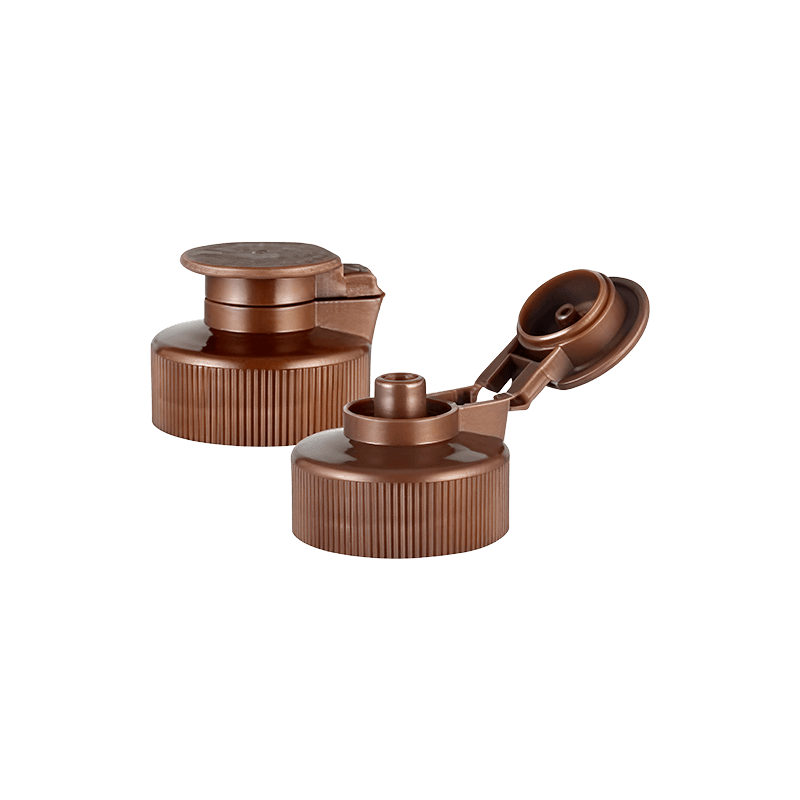
Plastic Flip Cap with Nozzle
Product Overview
The Plastic Flip Cap with Nozzle is a ribbed flip-top closure designed for liquid and semi-liquid packaging. It combines a screw-on base, hinged flip lid, and dispensing nozzle in one compact plastic component. The cap is intended to provide a secure seal while also allowing users to dispense the contents conveniently and repeatedly. Compared with traditional screw caps that must be fully removed before use, a flip cap improves convenience and reduces the risk of cap loss, contamination, or accidental spills.
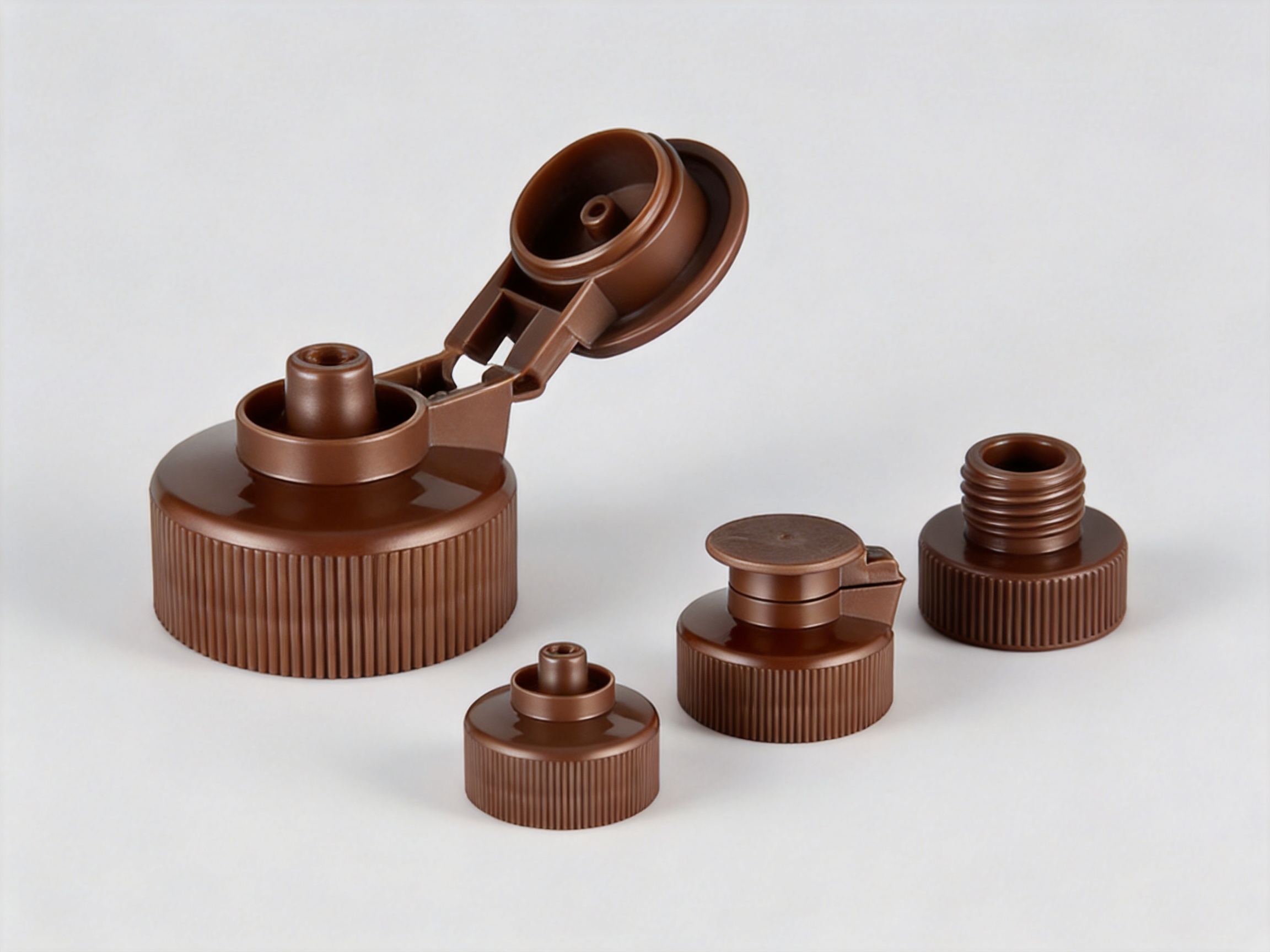
The available size options are 20-410, 24-410, 28-410, and 28-400. These neck finishes are widely used in personal care, household, and liquid packaging industries. The 20-410 option is suitable for smaller bottles and more compact products, while the 24-410 and 28-410 options fit many medium-sized personal care and cleaning bottles. The 28-400 option provides an alternative thread finish for customers with specific bottle designs or existing packaging lines.
The cap uses a ribbed closure type. Ribbing is not merely decorative; it improves the user’s ability to grip the cap, especially when hands are wet, oily, or covered with product. This is particularly important for bathroom products such as shampoo and body wash, where users often handle bottles in humid conditions. The ribbed texture also helps during capping operations because it provides a stable surface for mechanical engagement.
The nozzle is designed to guide the flow of liquid in a controlled way. Instead of pouring from a wide bottle opening, users can press or squeeze the bottle and dispense a more manageable amount. This feature is beneficial for shampoos, lotions, dishwashing liquids, sauces, and other products where controlled flow improves user experience and reduces waste. For brands, better dispensing performance can contribute to repeat purchases, because consumers often associate packaging convenience with product quality.
Key Specifications
Product Type |
Plastic flip cap with nozzle |
Model |
GY-201F |
Category |
Cosmetic plastic packaging bottle caps |
Available Sizes |
20-410, 24-410, 28-410, 28-400 |
Closure Type |
Ribbed flip-top closure |
Dispensing Feature |
Nozzle outlet for controlled dispensing |
Typical Uses |
Shampoo, body wash, lotion, dishwashing liquid, sauce, and selected liquid products |
Primary Advantages |
Easy grip, secure closure, convenient opening, controlled dispensing, multiple size options |
Manufacturing Strengths |
Mold design, injection molding, automated assembly, quality inspection, large-scale production capability |
Why the Cap Matters in Liquid Packaging
Many consumers judge packaging in seconds. If a cap is hard to open, leaks in a bag, dispenses too much product, or breaks after repeated use, the entire product experience suffers. Even when the liquid formula is high quality, poor packaging can lead to complaints, returns, or reduced customer loyalty. This is why the cap is not a secondary detail; it is a functional interface between the product and the user.
A flip cap with nozzle is especially useful because it balances sealing and accessibility. The screw thread secures the cap to the bottle, while the flip lid gives the user quick access to the dispensing opening. The nozzle helps control the flow, making the package suitable for products with different viscosities. For low-viscosity liquids, the nozzle helps reduce sudden pouring. For moderately viscous products, it supports steady dispensing when the bottle is squeezed.
Another important factor is hygiene. A cap that remains attached to the bottle is less likely to be dropped on a bathroom floor, kitchen counter, or outdoor surface. This is valuable for personal care and food-related packaging. The hinged design also encourages users to close the lid after use, helping protect the product from dust, moisture, and accidental contamination.
For manufacturers, cap performance affects filling-line productivity. A closure that is dimensionally stable and compatible with capping equipment can reduce downtime, rejects, and rework. Precise molding, reliable threading, and consistent hinge performance are therefore essential. When caps are produced with advanced injection molding and controlled inspection procedures, customers can expect more stable performance across large production batches.
Design Features and Functional Advantages
Ribbed Surface for Improved Grip
The ribbed closure is one of the most visible features of the cap. Ribbing gives the cap a textured surface that improves handling. In bathroom environments, users may have wet hands or slippery product residue on their fingers. A smooth cap can be difficult to twist or hold, but a ribbed cap provides friction and control. This improves everyday usability and reduces frustration.
Ribbing also supports packaging operations. During automated or semi-automated capping, the cap must be gripped and rotated onto the bottle neck. A consistent ribbed structure can help capping equipment apply torque more effectively. When the closure surface is designed with uniform ribs, it supports smoother production and helps reduce the chance of slippage during application.
Flip-Top Convenience
The flip-top design allows users to open and close the cap without removing it from the bottle. This is highly convenient for frequently used products such as shampoo, body wash, dishwashing liquid, and lotion. Consumers often use these products with one hand, and a flip cap supports this behavior. A cap that flips open quickly and closes securely creates a feeling of efficiency and quality.
Compared with traditional screw caps, flip caps reduce the risk of losing the closure. In households, screw caps can be misplaced, dropped, or left open. A flip cap remains attached to the bottle, helping keep the package complete throughout its use cycle. For brands, this means fewer user complaints related to missing caps or messy storage.
Nozzle for Controlled Dispensing
The nozzle is central to the product’s value. It creates a defined outlet that directs the liquid flow. This makes dispensing more predictable and cleaner than pouring from an open bottle mouth. For products such as shampoo and lotion, controlled dispensing helps consumers use the right amount. For dishwashing liquid, the nozzle supports targeted application onto a sponge, dish, or cleaning surface. For sauces, it can support controlled pouring or squeezing when the formulation and packaging requirements are suitable.
Controlled dispensing reduces waste. If a closure releases too much product at once, consumers may use more than needed. Over time, this can create dissatisfaction because the product runs out faster. A well-designed nozzle improves user control, helping the package feel more economical and thoughtful.
Multiple Neck Finish Options
The cap is available in 20-410, 24-410, 28-410, and 28-400. These options allow brands to use the same general cap style across different bottle sizes and product lines. For example, a brand may choose a 20-410 cap for a travel-size lotion, a 24-410 cap for a standard shampoo, and a 28-410 cap for a larger body wash or dishwashing liquid bottle. Maintaining a consistent closure style across product sizes can strengthen shelf appearance and simplify sourcing.
Multiple size options also reduce the need for custom tooling when customers use common bottle neck standards. This can shorten development time and support faster product launches. For customers that already use compatible bottles, the cap can be integrated into existing packaging structures with less disruption.
Secure Threaded Fit
A reliable threaded fit is essential for leakage prevention. The cap must match the bottle neck finish accurately. If the thread is poorly formed, the cap may cross-thread, loosen, or fail to seal properly. Through precision mold design and stable injection molding, the thread geometry can be controlled to support a secure fit. This is important for products shipped over long distances, stored in warehouses, and handled by retailers and consumers.
A secure closure also protects brand reputation. Leakage during transportation can damage labels, cartons, and other products in the same shipment. It can also create negative consumer experiences when a product leaks in a shopping bag or bathroom cabinet. A dependable threaded flip cap helps reduce these risks.
Advantages Over Common Competing Closures
Better Convenience Than Standard Screw Caps
Standard screw caps are simple and economical, but they require users to remove and replace the closure every time. This can be inconvenient for products used daily or in wet environments. A flip cap with nozzle improves convenience because the user only needs to lift the flip lid, dispense the product, and press the lid closed. The cap remains attached to the bottle, reducing the chance of misplacement.
For shampoos, lotions, and dishwashing liquids, this advantage is significant. Consumers often prefer packaging that supports quick use. The flip-top format creates a more modern and user-friendly experience than a basic screw cap, especially for mid-range and premium products.
Cleaner Dispensing Than Wide-Mouth Openings
Wide-mouth openings can release product too quickly, especially when the bottle is squeezed or tilted. This may lead to spills, waste, and messy residue around the neck. The nozzle design provides a more controlled path for liquid flow. It is especially useful for products where consumers need a small or moderate amount per use.
Cleaner dispensing can also improve shelf and countertop appearance. Bottles that leak or accumulate residue around the closure look unattractive. A nozzle helps direct the product where it should go, reducing unnecessary mess.
More User-Friendly Grip Than Smooth Caps
Smooth caps may look minimal, but they are not always practical. In real usage conditions, a closure must be easy to handle. Ribbed caps provide better friction and control. This is particularly valuable for elderly users, children under supervision, and anyone using the product with wet or slippery hands.
Competitors that use smooth surfaces may sacrifice usability for appearance. The ribbed design of this cap keeps the package functional while still allowing a clean, professional look. It also supports capping efficiency during production.
Broader Application Range Than Single-Purpose Closures
Some closures are designed for only one category, such as cosmetics or food sauces. This plastic flip cap with nozzle has a broader application range. It can be used for personal care products, daily toiletries, household cleaning products, and selected food liquid packaging. This versatility is valuable for distributors, packaging suppliers, and brands with multiple product lines.
Using one closure style across several categories can simplify inventory management. Instead of sourcing different caps for each product, customers can standardize around a versatile flip cap where compatibility permits. This reduces purchasing complexity and supports more efficient production planning.
Stronger Production Consistency Than Low-Precision Alternatives
In competitive markets, not all caps are produced with the same attention to dimensional control. Low-precision caps may show inconsistent thread fit, weak hinges, rough edges, uneven color, or variable closure force. These issues can create production delays and consumer complaints. A manufacturer with advanced mold design, injection molding expertise, automated assembly, and quality inspection can provide more consistent results.
GreenYard Tools Co., Ltd. has specialized in spray and packaging product manufacturing for 16 years. The company produces perfume sprayers, pump heads, caps, bottles, and daily chemical packaging solutions. With a daily production capacity of one million units, it is positioned to support both large-volume orders and stable long-term supply. This manufacturing background gives the cap an advantage over products from suppliers with limited equipment, less mature tooling capability, or weaker quality control systems.
Application in Personal Care Packaging
Personal care products demand packaging that is attractive, convenient, and dependable. Shampoo, body wash, body lotion, conditioner, liquid soap, and similar products are often used in bathrooms, gyms, hotels, salons, and travel settings. In these environments, packaging must resist moisture, support easy handling, and dispense product neatly.
The Plastic Flip Cap with Nozzle is well suited to shampoo and body wash because it can be opened quickly while the bottle remains in the user’s hand. The ribbed surface improves grip, and the flip lid allows the user to dispense the product without unscrewing the entire cap. For body lotion, the nozzle helps control the amount released, preventing excessive product from spilling into the palm.
Brands can also benefit from the cap’s appearance. A flip cap communicates convenience and everyday practicality. When matched with a well-designed PE or PET bottle, it can create a complete package that looks professional on retail shelves. The cap can support both economy and premium product lines depending on color, finish, bottle shape, and label design.
For hotels and travel products, smaller neck sizes such as 20-410 can be especially useful. Compact bottles need closures that are easy to use but not bulky. A flip cap with nozzle provides a practical solution for sample sizes, amenity packaging, and portable personal care products.
Application in Household Cleaning Packaging
Household cleaning products such as dishwashing liquid, liquid detergent, and general cleaning liquids require caps that can handle repeated use. Consumers may open and close the bottle many times per week, sometimes with wet or soapy hands. The ribbed design supports grip, while the nozzle helps direct the liquid onto a sponge, cloth, dish, or surface.
Dishwashing liquid is a particularly suitable application. Consumers usually want to dispense a controlled amount rather than pour freely. A nozzle flip cap allows them to apply the liquid directly and reduce waste. The cap’s secure closure also helps prevent leakage when bottles are stored near sinks or under cabinets.
In household packaging, durability is important. Bottles may be squeezed frequently, dropped, or exposed to temperature changes during shipping and storage. A well-produced plastic cap must resist cracking and maintain hinge function. Manufacturing consistency is therefore critical. Advanced injection molding and inspection help ensure that the closure performs reliably during repeated consumer use.
Application in Food and Sauce Packaging
The product information indicates that this cap can be used for some food packaging, including sauce applications. In food-related packaging, compatibility must always be evaluated carefully based on material selection, product formula, filling conditions, regulatory requirements, and customer specifications. When properly matched to the application, a flip cap with nozzle can provide a convenient dispensing solution for liquid or semi-liquid food products.
For sauces, controlled dispensing is valuable. Consumers often need to pour or squeeze a moderate amount onto food or into cooking. A nozzle can reduce accidental over-pouring and improve cleanliness. The flip lid helps protect the outlet between uses, which is important in kitchen environments.
Food packaging also requires attention to sealing and cleanliness. The cap must fit securely, and the dispensing area should be designed to reduce residue accumulation as much as possible. Manufacturers and brands should conduct appropriate compatibility and migration tests according to the target market and product type. With proper validation, the cap can be considered for suitable sauce and liquid food packaging applications.

Manufacturing Strengths Behind Product Reliability
Advanced Mold Design
The performance of a plastic cap begins with mold design. The mold determines the thread accuracy, hinge structure, rib definition, sealing surfaces, nozzle geometry, and overall dimensional stability. A poorly designed mold can lead to defects that no later process can fully correct. For a flip cap with nozzle, mold design is especially important because the product includes several functional areas in one component.
GreenYard Tools Co., Ltd. has advanced capabilities in mold design. This allows the company to develop packaging components that meet practical performance requirements rather than only visual expectations. Mold design must consider material flow, cooling, shrinkage, part ejection, surface finish, and long-term tool maintenance. For threaded closures, the mold must create consistent thread profiles. For the flip hinge, it must support repeated opening and closing. For the nozzle, it must ensure a clean outlet and predictable dispensing path.
Strong mold design capability also supports customization. Customers may require different colors, surface finishes, matching bottle designs, or performance adjustments. A manufacturer with in-house or advanced mold design knowledge can respond more effectively to development needs and reduce the risk of delays.
Precision Injection Molding
Injection molding is the core production process for plastic caps. During this process, plastic material is heated, injected into the mold cavity, cooled, and ejected as a finished or semi-finished component. The process must be carefully controlled to ensure consistent dimensions and appearance.
For this plastic flip cap, injection molding quality affects many critical details. The ribs must be sharp enough for grip but not rough. The thread must be accurate enough to fit the bottle. The hinge must be strong and flexible. The nozzle opening must be clean. The sealing surfaces must form properly. Inconsistent molding can cause leakage, weak closure force, flash, warpage, or poor appearance.
Advanced injection molding equipment and process control help reduce these risks. Stable temperature, pressure, cooling time, and material handling are essential. When production is managed professionally, customers receive caps that perform consistently from batch to batch.
Automated Assembly
Automated assembly improves production efficiency and consistency. In the packaging industry, high-volume orders require reliable output. Manual processes may be suitable for small runs, but they can introduce variability in larger production. Automated assembly helps maintain speed and repeatability.
For caps and related packaging products, automation can support tasks such as component feeding, orientation, fitting, closing, inspection preparation, and packing. It reduces handling damage and helps maintain cleanliness. In a factory with a daily production capacity of one million units, automation is essential for meeting customer demand while controlling quality.
Automated production also supports cost competitiveness. By improving efficiency, reducing labor variability, and lowering defect rates, the manufacturer can offer customers stable supply and better value. This is an important advantage over competitors that rely heavily on manual operations or have limited production scale.
Quality Inspection
Quality inspection is necessary because the cap’s performance depends on small details. Inspection may include dimensional checks, visual checks, thread fit evaluation, closure function testing, hinge performance observation, color consistency review, and leakage-related testing when assembled with compatible bottles. The goal is to identify potential issues before products reach customers.
For a flip cap with nozzle, inspection should pay attention to the hinge, flip lid engagement, thread formation, sealing area, nozzle cleanliness, and surface defects. The cap should open and close smoothly. It should not have sharp flash or deformation. It should match the required neck finish. When used with the correct bottle and liner or sealing design if applicable, it should support secure closure.
GreenYard’s quality inspection capability strengthens the product’s reliability. Customers in personal care, household, and food-related packaging need confidence that caps will perform during filling, shipment, retail display, and consumer use. A structured inspection system helps provide that confidence.
Company Capability and Industry Experience
GreenYard Tools Co., Ltd. is a high-end packaging material manufacturer from China specializing in spray product manufacturing for 16 years. The company’s product range includes perfume sprayers, pump heads, caps, bottles, and daily chemical packaging solutions. This broad experience is important because modern packaging often requires complete system thinking. A cap must match the bottle, the product formula, the filling line, and the consumer’s usage habits.
The company’s daily production capacity of one million units shows strong manufacturing scale. For customers, this means the ability to support large orders and repeat purchases. Capacity is not only about volume; it also affects delivery stability. A supplier with mature production planning and high output can respond better to seasonal demand, promotional launches, and long-term supply agreements.
The company’s capabilities in mold design, injection molding, automated assembly, and quality inspection provide a complete manufacturing foundation. Instead of depending only on external processes, a manufacturer with integrated capabilities can control more aspects of quality and timing. This can shorten development cycles, improve communication, and reduce the risk of mismatched components.
A dedicated design team also supports product innovation. Packaging markets change quickly, and customers often need updated designs, improved ergonomics, new colors, or custom solutions. A design-focused manufacturer can help customers develop packaging that is not only functional but also competitive in appearance and user experience.
Material and Structural Considerations
Although the provided product information identifies the cap as a plastic closure, the exact material selection should be confirmed according to customer requirements and application. Plastic caps for personal care and household products commonly use materials selected for moldability, durability, chemical compatibility, and hinge performance. Material choice influences stiffness, flexibility, stress resistance, color appearance, and sealing behavior.
For a flip cap, the hinge area is particularly important. It must flex repeatedly without cracking too quickly. The lid must close securely while remaining easy to open. The base must remain dimensionally stable to maintain thread fit. The nozzle must be formed cleanly and resist deformation during handling.
Chemical compatibility is another key consideration. Shampoo, lotion, dishwashing liquid, sauce, and cleaning products may contain surfactants, oils, fragrances, acids, salts, or other ingredients. Before mass production, the customer should test the cap with the actual formula under expected storage and transportation conditions. This helps confirm that the closure maintains performance and appearance over time.
Color customization may be available depending on production requirements. Caps can often be produced in colors that match brand identity, bottle design, or product category. A white cap may communicate cleanliness, a black cap may create a premium look, and bright colors may help distinguish product variants. Consistent color control is important for shelf appeal and brand recognition.
Packaging Line Compatibility
A successful closure must work not only for consumers but also for filling factories. Packaging line compatibility includes cap feeding, orientation, torque application, thread engagement, and post-capping inspection. If a cap does not feed smoothly or varies in dimension, the line may experience jams, misapplied caps, leakage, or downtime.
The ribbed design can help mechanical handling, while precise threads support consistent capping. The available neck finish options make it easier for customers to match the cap with standard bottles. However, every packaging line is different, so customers should conduct line trials before full-scale production. These trials can confirm torque settings, closure fit, dispensing behavior, and carton packing performance.
Compared with low-cost generic caps that may have inconsistent dimensions, a cap produced under controlled manufacturing conditions is more likely to perform reliably on automated lines. This can save customers significant costs by reducing stoppages, rejects, and manual rework.
Leakage Control and Sealing Performance
Leakage control is one of the most important performance areas for any liquid packaging cap. Leakage can occur through the thread area, around the sealing surface, through the nozzle, or due to improper closure of the flip lid. A well-designed cap reduces these risks through accurate geometry and dependable closure engagement.
The screw-on base must connect securely with the bottle neck. The thread finish must match the bottle specification. The sealing area must contact the bottle properly. The flip lid must close firmly over the nozzle outlet. Each of these elements depends on precise molding and inspection.
It is important to note that leakage performance is a system result. The cap, bottle, product formula, filling temperature, headspace, torque, shipping conditions, and storage position all contribute. A good cap provides the foundation, but customers should validate the complete package. Drop testing, vibration testing, inverted storage testing, temperature cycling, and transport simulation may be used depending on the product category and market requirements.
User Experience and Brand Value
Packaging influences how consumers feel about a product. A cap that opens smoothly, closes securely, and dispenses neatly can make a product feel more refined. Consumers may not consciously analyze the closure design, but they notice when it works well. They also notice when it leaks, sticks, breaks, or dispenses too much.
The Plastic Flip Cap with Nozzle supports positive user experience in several ways. The ribbed surface is easy to grip. The flip lid is convenient. The nozzle helps control flow. The multiple size options allow brands to create consistent packaging families. These features help the product feel practical and dependable.
For brand owners, this can translate into stronger customer satisfaction. A good closure reduces complaints and supports repeat purchases. It can also help products stand out in crowded categories such as shampoo, body wash, lotion, and dishwashing liquid. When combined with an attractive bottle and label, the cap becomes part of a complete packaging identity.

Customization and Supply Flexibility
Modern brands often need packaging that reflects their identity. While the standard cap already offers strong functionality, customization may include color matching, surface finish adjustments, size selection, bottle pairing, and packaging system recommendations. A manufacturer with strong design and production capabilities can support these needs more effectively than a supplier that only sells standard inventory.
GreenYard’s experience in caps, bottles, pump heads, perfume sprayers, and daily chemical packaging solutions allows it to understand packaging as a complete system. Customers can benefit from this knowledge when selecting compatible bottles, choosing closure sizes, or planning product families. The company’s manufacturing scale also supports stable supply for both established brands and growing businesses.
Supply flexibility is especially important in global markets. Brands may need consistent packaging across different regions, seasonal promotions, or multiple product lines. A supplier with high daily capacity and mature production processes can support long-term cooperation. This helps customers reduce sourcing risk and maintain consistent product presentation.
Sustainability and Practical Efficiency
Sustainability in packaging involves material efficiency, production control, durability, transportation efficiency, and reduced waste during use. A cap that dispenses product accurately can help consumers avoid using too much. A closure that prevents leakage can reduce product loss during shipping and storage. A durable cap can ensure the package remains usable until the contents are finished.
Manufacturing efficiency also contributes to sustainability goals. Advanced injection molding can reduce defect rates and material waste. Automated assembly can improve consistency and reduce unnecessary rework. Quality inspection can prevent defective products from entering the supply chain. Although a cap is small, producing millions of units efficiently can have a meaningful impact on resource use.
Brands seeking more sustainable packaging should evaluate the complete system, including resin selection, bottle compatibility, recyclability, lightweighting, and local regulations. The flip cap can be part of a practical packaging solution when designed and selected responsibly.
Recommended Selection Guidelines
When choosing this plastic flip cap with nozzle, customers should first confirm bottle neck compatibility. The available options are 20-410, 24-410, 28-410, and 28-400. The bottle neck finish must match the cap size to ensure proper thread engagement and sealing. If there is uncertainty, samples should be tested with the actual bottle before mass production.
Second, customers should consider product viscosity. A thin liquid may flow quickly, while a thick lotion may require squeezing. The nozzle should be evaluated with the actual formula to confirm dispensing speed, cleanliness, and user comfort. Testing should include normal use conditions and possible storage positions.
Third, customers should confirm chemical compatibility. Ingredients such as fragrances, oils, cleaning agents, acids, or salts may interact differently with plastics. Long-term storage tests can help confirm that the cap does not crack, discolor, deform, or lose closure performance.
Fourth, customers should conduct leakage and transport tests. These may include inverted storage, vibration, drop testing, and temperature cycling. Testing is especially important for e-commerce packaging, export shipments, and products sold in hot or cold climates.
Fifth, customers should evaluate packaging line performance. Samples should be tested on capping equipment to determine feeding behavior, torque settings, and closure consistency. A cap that works well on the filling line can reduce production costs and improve delivery reliability.
Common Use Scenarios
Bathroom Products
For shampoo, conditioner, body wash, and liquid soap, the cap supports convenient one-hand use. The ribbed surface provides grip in wet environments, and the flip lid helps prevent cap loss. The nozzle dispenses product directly into the hand or onto a sponge.
Body Care Products
For lotion and body care liquids, the nozzle helps users control the amount dispensed. This can reduce mess and improve perceived product value. The cap can be matched with different bottle sizes for travel, standard retail, or family packaging.
Kitchen Cleaning Products
For dishwashing liquid, the cap allows targeted application. Users can squeeze the bottle and dispense liquid onto a sponge or dish. The ribbed cap is easy to handle even when hands are wet.
Selected Sauce Packaging
For suitable sauce products, the cap can support controlled dispensing. Brands should conduct food-contact and compatibility testing according to target market requirements. When properly validated, the cap can improve kitchen convenience and reduce over-pouring.
Why Choose This Product for Competitive Packaging
This cap offers a practical combination of versatility, usability, and manufacturing reliability. Its multiple neck sizes allow broad bottle compatibility. Its ribbed surface improves grip. Its flip-top structure adds convenience. Its nozzle provides controlled dispensing. Its application range covers personal care, household cleaning, and selected food liquid packaging.
Compared with many competing closures, it provides stronger everyday functionality. It is more convenient than standard screw caps, cleaner than wide-mouth openings, easier to grip than smooth caps, and more versatile than single-category closures. These advantages can help brands improve consumer satisfaction and strengthen packaging value.
The manufacturing background behind the product further increases its appeal. GreenYard Tools Co., Ltd. combines 16 years of industry experience with mold design, injection molding, automated assembly, quality inspection, and large-scale production capacity. This supports stable quality, reliable supply, and the ability to serve global customers with packaging solutions.
For buyers, the choice of closure affects more than the bottle opening. It affects production efficiency, transportation safety, consumer convenience, and brand image. The Plastic Flip Cap with Nozzle is designed to meet these needs with a balanced, practical, and scalable solution.
Quality Control Points for Buyers
Professional buyers should evaluate several key quality points when sourcing this type of cap. The first point is thread accuracy. The cap should screw onto the bottle smoothly without cross-threading or excessive looseness. The second point is flip-lid function. The lid should open without breaking and close with a secure feel. The third point is nozzle quality. The dispensing opening should be clean and free from blockage or irregular flash.
The fourth point is sealing performance. When paired with the correct bottle, the closure should resist leakage under expected use and transportation conditions. The fifth point is surface appearance. Caps should have consistent color, clean molding, and no obvious defects. The sixth point is batch consistency. Buyers should confirm that samples from different production batches remain stable in fit and function.
Working with a manufacturer that has strong inspection systems helps reduce sourcing risk. Buyers should also communicate application details clearly, including product formula, bottle type, filling process, shipment conditions, and market standards. Clear communication allows the manufacturer to recommend suitable options and testing procedures.
Q&A Section
Q1: What products is the Plastic Flip Cap with Nozzle suitable for?
It is suitable for shampoo, body wash, lotion, dishwashing liquid, liquid soap, sauce, and other compatible liquid or semi-liquid products. It is widely used in daily toiletries and household products, and it may also be used for selected food packaging after proper validation.
Q2: What size options are available?
The available size options are 20-410, 24-410, 28-410, and 28-400. These neck finishes are common in personal care, household, and liquid packaging applications.
Q3: Why is the ribbed closure design useful?
The ribbed surface improves grip, especially when hands are wet or slippery. It also supports better handling during capping operations and gives users a more secure feel when opening or tightening the cap.
Q4: How does the nozzle improve dispensing?
The nozzle directs the liquid flow and helps users dispense a controlled amount. This reduces waste, improves cleanliness, and makes the package easier to use for products such as shampoo, lotion, dishwashing liquid, and sauce.
Q5: Is this cap better than a standard screw cap?
For many daily-use liquid products, yes. A standard screw cap must be removed completely, while a flip cap stays attached to the bottle and opens quickly. This improves convenience, reduces cap loss, and supports cleaner repeated use.
Q6: Can this cap be used for food packaging?
It can be considered for some food packaging, such as suitable sauces, but customers should confirm material compatibility, food-contact requirements, formula interaction, and regulatory standards for the intended market before use.
Q7: What manufacturing advantages support the cap’s quality?
The product is supported by advanced mold design, precision injection molding, automated assembly, and quality inspection. These processes help ensure consistent thread fit, reliable hinge performance, clean appearance, and stable production quality.
Q8: Why is production capacity important for buyers?
Large production capacity supports stable supply, repeat orders, and high-volume projects. With a daily production capacity of one million units, the manufacturer can better serve customers with large or ongoing packaging requirements.
Q9: What should buyers test before mass production?
Buyers should test bottle compatibility, torque performance, leakage resistance, dispensing behavior, chemical compatibility, filling-line performance, and transportation durability. Testing with the actual formula and bottle is strongly recommended.
Q10: Can the cap support brand customization?
Yes, customization may include size selection, color matching, bottle pairing, and packaging system recommendations, depending on order requirements and production feasibility. The manufacturer’s design and tooling capabilities support customized packaging development.
Conclusion
The Plastic Flip Cap with Nozzle is a practical and versatile closure for modern liquid packaging. With size options including 20-410, 24-410, 28-410, and 28-400, it can match a wide range of bottles used in personal care, household cleaning, and selected food liquid applications. Its ribbed closure improves grip, its flip-top structure enhances convenience, and its nozzle supports controlled dispensing.
In comparison with common competing closures, it offers clear advantages in usability, cleanliness, handling, and application flexibility. It is more convenient than standard screw caps, more controlled than wide-mouth openings, and easier to grip than smooth closures. These features can improve consumer satisfaction and help brands create a more dependable packaging experience.
The product’s value is strengthened by the manufacturing capabilities behind it. With 16 years of experience, large-scale production capacity, mold design expertise, injection molding technology, automated assembly, and quality inspection systems, GreenYard Tools Co., Ltd. provides a strong foundation for consistent quality and reliable supply. For brands and packaging buyers seeking a functional, scalable, and consumer-friendly closure, this plastic flip cap with nozzle is a strong choice for daily-use liquid packaging.
References
1. Soroka, W. Fundamentals of Packaging Technology. Institute of Packaging Professionals.
2. Yam, K. L. The Wiley Encyclopedia of Packaging Technology. John Wiley and Sons.
3. Coles, R., McDowell, D., and Kirwan, M. J. Food Packaging Technology. Blackwell Publishing.
4. Han, J. H. Innovations in Food Packaging. Academic Press.
5. Robertson, G. L. Food Packaging: Principles and Practice. CRC Press.
6. Rosato, D. V., Rosato, M. G., and Rosato, D. V. Injection Molding Handbook. Springer.
7. Selke, S. E. M., Culter, J. D., and Hernandez, R. J. Plastics Packaging: Properties, Processing, Applications, and Regulations. Hanser Publications.
8. Giles, G. A. Handbook of Package Engineering. CRC Press.
Product: Plastic Flip Cap with Nozzle

-
Amber Plastic Bottles: Lightweight, Protective, Customizable Packaging for Cosmetics
You have spent months stabilizing a vitamin C serum, only to watch a pallet of amber glass bottles ...
-
Crimp Pumps Demystified: Choosing the Right Type and Material for Every Cosmetic Formula
Walk into any cosmetic filling facility and you will find crimp pumps on everything from a delicate ...
-
How Glass Airless Bottle Packaging Prevents Contamination and Boosts Shelf Life?
Glass airless bottle packaging prevents contamination and extends shelf life by completely eliminat...
-
What Makes a Good Deodorant Stick Bottle for Brands?
A deodorant stick bottle is a twist-up or push-up dispensing container designed to hold and advance...
Copyright © GreenYard Tools Co.,ltd. All Rights Reserved.
Personal Care Packaging Manufacturer Custom Perfume Sprayers Factory